KRA eTIMS Integration Guide for ERP, POS, and Invoicing Systems in Kenya
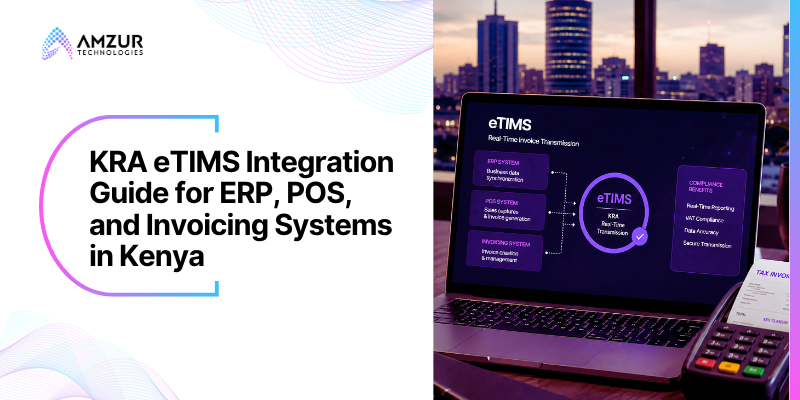
For many Kenyan businesses, eTIMS has evolved from a mere tax compliance requirement into a significant opportunity for enhancing transaction control. The focus has shifted from just generating electronic tax invoices to ensuring that the data across various systems, such as sales, finance, inventory, and customer records, is accurate, traceable, and defensible.
It’s crucial to view KRA eTIMS integration as more than just a tax plug-in; it should be approached as an integral business systems layer. This layer connects invoicing, VAT, payments, credit notes, returns, audit trails, and operational reporting, creating a more streamlined and efficient process.
The KRA‘s mandate for all businesses to onboard eTIMS and issue electronic tax invoices signals a transformative shift. Starting 1 January 2024, requiring electronic tax invoices to support business expense claims emphasizes the importance of integrating eTIMS into the daily operational framework of every business. This alignment not only facilitates compliance but also enhances the overall effectiveness of business operations, driving value beyond tax obligations.
Explore more about the eTIMS-ready ERP solutions for Kenyan businesses.
What is KRA eTIMS integration?
KRA eTIMS integration is the process of connecting a Kenyan business’s ERP, POS, or invoicing system directly to the Kenya Revenue Authority’s electronic Tax Invoice Management System (eTIMS) to transmit invoice data electronically and achieve tax compliance. Under KRA’s mandate effective January 1, 2024, all Kenyan businesses must issue electronic tax invoices and integrate their systems with eTIMS.
The integration occurs through two technical routes:
OSCU (Online Submission Clearing Unit)
For businesses with always-online invoicing systems and stable internet connectivity.
VSCU (Offline Submission Clearing Unit)
For businesses using bulk invoicing or operating in environments with intermittent connectivity
For Kenyan CFOs, COOs, and finance leaders, KRA eTIMS integration is not merely a tax compliance checkbox. It represents a foundational layer connecting invoicing, VAT, payments, credit notes, returns, audit trails, and operational reporting into one traceable system.
Why does eTIMS integration matter for Kenyan Businesses
A business may use ERP for finance, POS for sales, e-commerce for customer orders, and a separate tool for invoicing. If these systems do not speak to each other clearly, eTIMS can expose every data gap.
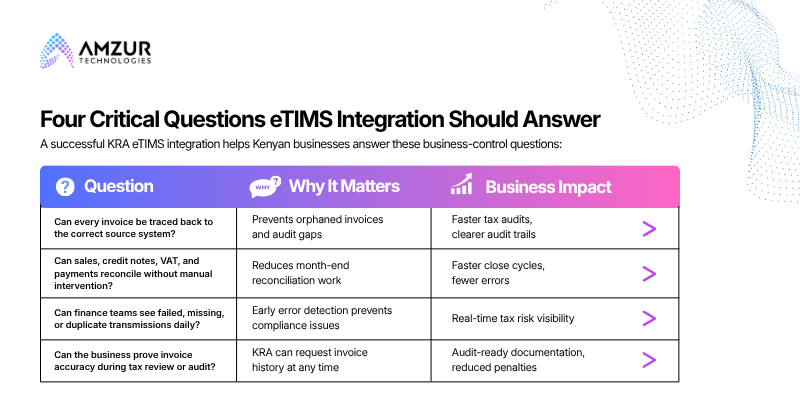
Successful KRA eTIMS integration should help businesses answer four questions:
Four Critical Questions eTIMS Integration Should Answer
A successful KRA eTIMS integration helps Kenyan businesses answer these business-control questions:
Many Kenyan businesses underestimate this project because they focus narrowly on “sending invoices to KRA.” The larger strategic goal is building a reliable, auditable transaction trail that supports business growth without manual workarounds.
eTiMS ERP’s Integration Industry-Specific Impact in Kenya
The operational impact of KRA eTIMS integration varies significantly by industry sector:
| Industry | Common Challenge | Integration Benefit |
|---|---|---|
| Retail & Supermarkets | POS devices fail or transmit invoices late; multiple branch reconciliation | Real-time daily sales verification, tax accuracy by branch |
| Wholesale Distribution | Customer PIN mismatches; input VAT claims rejected | Accurate buyer PIN capture, VAT claim protection |
| Manufacturing | ERP invoices don't align with dispatch and stock records | Complete audit trail linking invoicing to production |
| Food & Beverage | High-volume orders create invoice gaps and returns management complexity | Traceability for retailer compliance, credit note control |
| Healthcare & Pharma | Supplier and inventory records must meet compliance requirements | Regulated stock visibility, procurement audit trail |
| Multi-Branch Services | Teams invoice through different tools, creating consolidation nightmares | Unified reporting across branches, single source of truth |
How KRA eTIMS integration flow across ERP, POS, and finance systems?
The best integration design starts with workflow clarity. Businesses should define how an invoice moves from transaction creation to tax transmission, payment matching, and finance reporting.
The 7-Step eTIMS Integration Workflow
| Step | System Action | Business Control |
|---|---|---|
| 1 | ERP, POS, or invoicing system creates the invoice | Invoice ownership is clear |
| 2 | Customer PIN, item, tax, and branch data are validated | Reduces VAT and reporting errors |
| 3 | Invoice is transmitted through OSCU or VSCU | Creates a KRA-aligned tax record |
| 4 | KRA response or transmission status is captured | Tracks success, failure, or retry |
| 5 | ERP/POS invoice is reconciled with KRA-transmitted data | Supports VAT and audit readiness |
| 6 | Payment is matched against the invoice | Improves cash visibility |
| 7 | Credit notes or returns are controlled from the source system | Protects the audit trail |
This flow shows why KRA eTIMS integration with ERP is not merely an API connection. It is a business-control workflow. If any step is weak, finance teams will still rely on manual checks, downloaded reports, spreadsheets, or branch-level follow-ups.
Explore our NetSuite ERP solutions for Kenyan businesses
OSCU vs. VSCU: Which KRA eTIMS Integration Route Is Right for Your Business?
The OSCU vs VSCU decision should start with operations, not technology preference.
KRA describes VSCU as suitable for taxpayers undertaking bulk invoicing and not always online, while OSCU suits taxpayers whose invoicing is always online. Both allow system-to-system integration between a taxpayer’s invoicing or ERP system and eTIMS.
Decision Matrix for Kenyan Businesses
| Business Scenario | Route to Evaluate | What to Assess Before Deciding |
|---|---|---|
| Always-online ERP-led invoicing | OSCU | ERP availability, invoice volume, API readiness |
| Bulk invoicing or intermittent connectivity | VSCU | Batch flow, offline handling, retry process |
| Retail POS with many branches | POS-to-eTIMS architecture | Branch setup, device mapping, queueing, failures |
| Distributor with centralized billing | ERP-led integration | Customer master, tax codes, invoice ownership |
| Manufacturer with dispatch-linked invoicing | ERP and warehouse workflow | Delivery note, invoice, stock movement alignment |
| Mixed ERP, POS, ecommerce, and invoicing tools | Source-of-truth design | Which system creates the official invoice |
Critical Note for Kenyan Businesses: A high-volume retail chain cannot choose OSCU or VSCU before mapping POS device count, branch internet reliability, daily transaction volume, returns frequency, customer PIN collection processes, and sales reconciliation workflows. A wholesale distributor using centralized ERP billing may need a different architectural approach from a supermarket with 20+ POS terminals.
This is why businesses evaluating OSCU integration services, VSCU integration services, or eTIMS API integration in Kenya should first request a structured integration-readiness assessment.
Critical: Data Readiness Before KRA eTIMS Integration
Many eTIMS projects fail because Kenyan businesses connect their systems before cleaning the data that feeds those systems. Before KRA eTIMS API work begins, finance and IT teams must review and validate all master data.
Core principle: If your master data is weak, eTIMS integration only moves bad data faster into KRA’s system—creating rejected invoices and compliance risk.
Master Data Validation Checklist
| Data Element | Why It’s Critical | Consequence If Incomplete |
|---|---|---|
| Customer PIN | Required for business-to-business purchases and input VAT claims in Kenya | Invoices without valid PINs cannot be used for VAT deductions |
| Item codes and descriptions | Supports invoice accuracy and tax classification | Inconsistent naming causes data gaps during reconciliation |
| VAT, zero-rated, and exempt tax mapping | KRA auto-populates VAT returns from eTIMS data | Miscoding creates VAT return mismatches and audit risk |
| Branch and device setup | Controls invoice sequence numbers and location-based reporting | Duplicate sequences or unclear branch attribution creates audit gaps |
| Invoice numbering logic | Prevents duplicate and missing invoice records | Duplicates can trigger KRA suspicion; missing sequences cause compliance gaps |
| Credit note rules | Protects reversals and return control | Uncontrolled credit notes expose businesses to KRA adjustment |
| Currency handling | Prevents foreign exchange conversion errors on invoices | Mishandled currency can create VAT and reporting errors |
| User roles and permissions | Controls who can create, approve, cancel, or adjust invoices | Weak controls create audit trail gaps |
| Failed transmission logic | Ensures errors are resolved before filing | Failed invoices not retried create missing records in KRA’s system |
KRA’s VAT auto-populated return guidance shows why this matters. VAT returns are pre-filled using information from iTax, TIMS, eTIMS, and customs systems, and VAT-registered taxpayers must issue or demand electronic tax invoices, transmit invoice details, and verify return accuracy.
If master data is weak, automation only moves bad data faster.
How KRA eTIMS Integration Protects VAT Reconciliation (The Real Value)
VAT reconciliation is one of the most commercially important outcomes of KRA eTIMS integration.
KRA states that input VAT claims are only allowed if they originate from invoices transmitted through TIMS/eTIMS, comply with VAT law and related regulations, or meet valid customs import declaration requirements. KRA also states that transmitted invoices without buyer PIN cannot be claimed in the VAT return.
This means invoice transmission, supplier compliance, buyer PIN accuracy, ERP records, and VAT returns must align.
For finance teams, the goal is not just eTIMS compliance. The goal is cleaner VAT reconciliation. Businesses should be able to compare ERP sales invoices, POS invoices, KRA-transmitted invoices, credit notes, purchase invoices, input VAT, and ledger entries without rebuilding reports manually.
KRA also lists several causes of VAT return discrepancies, including transmission challenges, configuration issues between devices and invoicing systems, duplicate sales invoices, incorrect classification of zero-rated and exempt supplies, and foreign currency exchange-rate configuration issues.
These are not small technical issues. They affect filing confidence, audit readiness, and finance productivity.
For CFOs, this is the practical value of KRA eTIMS integration: fewer month-end surprises, fewer missing invoice follow-ups, better supplier control, and stronger confidence in tax reporting.
Why do credit notes and source-system ownership matter?
Credit notes are one of the most overlooked risks in eTIMS integration projects.
KRA’s eTIMS enhancement allows taxpayers to use different eTIMS solutions simultaneously and access invoices generated from eTIMS Client, VSCU, OSCU, and eCitizen through the online taxpayer portal. However, KRA also states that credit notes can only be generated from the solution where the original invoice was raised.
This creates a major ERP and POS architecture question: where should the official invoice originate?
If one branch creates invoices through POS, another through ERP, and another through a secondary invoicing tool, credit notes can become difficult to control. Returns, reversals, pricing corrections, and cancellations may create audit gaps if source-system ownership is unclear.
A strong KRA eTIMS integration project should define invoice-origin rules before go-live.
For example, if retail branches issue invoices through POS, then return and credit-note processes must also be controlled through that POS-led workflow. If B2B invoices are generated from ERP, credit notes should follow ERP controls.
If ecommerce invoices flow through a third-party platform, the integration design must define whether that platform, ERP, or another tool owns the official invoice.
Without this clarity, finance teams may spend months correcting problems that should have been prevented in the design stage.
Six Common KRA eTIMS Integration Mistakes To Avoid
Businesses often make six mistakes during KRA eTIMS integration.
First, they treat eTIMS as a tax add-on instead of a transaction-control layer. This limits the project to invoice transmission and ignores VAT reconciliation, credit notes, payments, and audit reporting.
Second, they choose OSCU or VSCU before mapping actual business workflows. A business with multiple branches, mixed POS systems, and high-volume transactions needs a different design from a centralized B2B invoicing business.
Third, they ignore master data quality. Poor customer PINs, wrong item codes, incorrect tax mapping, and inconsistent branch data will create problems after integration.
Fourth, they fail to plan for errors. Failed transmissions, duplicate invoices, missing invoices, late transmissions, and rejected records need clear ownership and daily monitoring.
Fifth, they overlook credit notes and returns. This becomes especially risky when businesses use multiple invoicing solutions.
Sixth, they do not build finance dashboards. If finance cannot see transmission status, VAT differences, missing buyer PINs, and failed records, the integration will not reduce manual work.
These mistakes explain why an eTIMS integration implementation Kenya project should include finance controls, operational workflows, and reporting design, not just API development.
What should an eTIMS integration readiness checklist include?
Before investing in eTIMS ERP integration services, eTIMS POS integration services, or KRA eTIMS integration services, Kenyan businesses should complete a structured readiness review.
Pre-Integration Readiness Assessment (8-12 Weeks Before Go-Live)
| Readiness Area | What to Validate | Owner | Target Completion |
|---|---|---|---|
| Business Process Mapping | Document where invoices originate (POS, ERP, e-commerce), how returns flow, and where credit notes are issued | COO + Finance + IT | Week 2 |
| System Landscape Audit | Identify all systems creating invoices: ERP, POS, e-commerce platform, invoicing tool, payment processor, and warehouse management | IT | Week 3 |
| Integration Route Selection | Evaluate OSCU vs. VSCU based on invoice volume, internet reliability, and batch vs. real-time needs | IT + Finance | Week 4 |
| Master Data Cleansing | Validate and remediate customer PINs, item codes, tax codes, branch setup, invoice numbering, and user roles | Finance + IT | Week 6 |
| Finance Controls Design | Define VAT reconciliation workflow, failed-invoice response, payment-to-invoice matching, and audit trail requirements | CFO + Finance | Week 5 |
| Exception Handling Plan | Document who handles failed transmissions, how long investigations should take, and the retry process | Finance + IT | Week 7 |
| Reporting & Dashboard Design | Prioritize dashboards for transmission status, failed invoices, VAT reconciliation, missing PINs, and payment matching | Finance + IT | Week 8 |
| Go-Live Plan | Sandbox testing schedule, user training plan, parallel-run period where applicable, and fallback process | Project Manager | Week 10 |
| Post-Go-Live Ownership | Define who monitors errors daily, who is on call for failures, and the escalation path | Operations + Finance | Week 9 |
| Scalability Planning | Determine how the system will handle new branches, new POS devices, new invoicing tools, and higher transaction volumes | IT + COO | Week 11 |
A readiness checklist turns KRA eTIMS integration from a rushed compliance project into a structured finance-control project.
It also helps decision-makers avoid a common trap: choosing a technical route before understanding the business process.
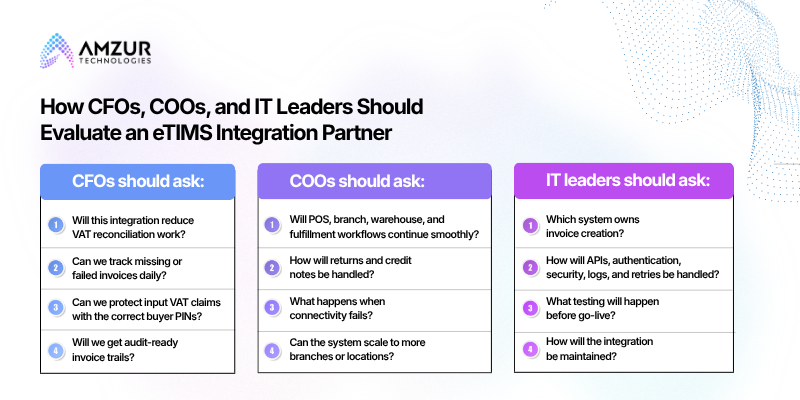
How CFOs, COOs, and IT Leaders Should Evaluate an eTIMS Integration Partner
The right partner should understand both systems and business operations.
A strong eTIMS integration consultant in Kenya should explain how ERP, POS, and invoicing workflows will connect, how failed transmissions will be monitored, how credit notes will be controlled, how VAT reconciliation will improve, and how branch teams will use the process after go-live.
Check out which is the best cloud ERP for Kenyan businesses
Conclusion: Why Amzur sees eTIMS as an ERP modernization opportunity
KRA eTIMS integration is not only about connecting systems to KRA. It is about building a cleaner, more reliable transaction foundation for Kenyan businesses.
When designed well, it helps finance teams reduce manual reconciliation, protect VAT claims, improve audit readiness, control credit notes, and trust transaction data. When designed poorly, it can create more errors, more exceptions, and more pressure during filing.
For growing Kenyan businesses using NetSuite or evaluating cloud ERP, this is the right moment to think beyond compliance. The better question is: Can your ERP, POS, and invoicing systems support growth while keeping every transaction traceable, compliant, and finance-ready?
Amzur helps businesses answer that question. As a trusted NetSuite solutions provider, Amzur supports growing Kenyan companies with ERP implementation, customization, integration, finance automation, inventory visibility, order-to-cash, procure-to-pay, POS integration, warehouse operations, and reporting.
For businesses planning NetSuite eTIMS integration in Kenya, Amzur can help assess the current system landscape, design the right integration roadmap, and build ERP workflows that support compliance, control, and scalable growth.

Author: Serghino Felix
Sr. Director – of Enterprise Applications
Serghino Felix is a seasoned ERP professional with nearly two decades of experience in the enterprise applications space. Known for connecting strategy with execution, he has built a career around turning complex business challenges into scalable, practical solutions, while keeping people and outcomes at the center of every engagement. His expertise spans delivery leadership, customer partnership, and strengthening enterprise application practices that drive real business transformation.