NetSuite Cloud ERP Solutions vs Odoo ERP for Kenya: The Complete Selection Guide
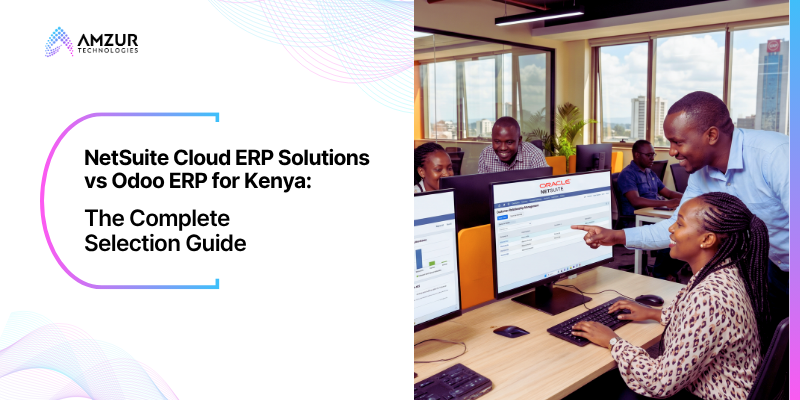
Kenyan businesses are no longer buying ERP only to automate accounting. They are buying ERP to handle compliance, eTIMS invoicing, inventory visibility, payment reconciliation, data governance, multi-location operations, and faster finance decisions.
That is why the comparison between NetSuite Cloud ERP solutions and Odoo ERP matters. Both platforms can support growing businesses. But they are built for different operating realities.
Odoo is a modular business application suite with apps for accounting, CRM, inventory, POS, e-commerce, HR, projects, manufacturing, and more. Odoo’s official Apps Store positions it as an open-source suite of business apps covering common business needs from CRM and ecommerce to accounting and inventory.
NetSuite, on the other hand, is positioned by Oracle as a unified cloud business management suite covering ERP/Financials, CRM, and e-commerce. NetSuite documentation also shows ERP coverage across accounting, inventory, order management, project management, employee management, taxes, fixed assets, multi-book accounting, and financial reporting.
For Kenyan businesses, the decision should not start with software popularity. It should start with business maturity.
Who This Guide Is For
This comparison is designed for:
- Kenyan SMEs and mid-market businesses earning KES 50M–2B annually considering their first or next ERP investment.
- Finance leaders and operations managers tasked with selecting an ERP that balances cost, compliance (eTIMS, ODPC), and scalability.
- Regional businesses planning expansion across East Africa and needing multi-entity, multi-currency financial control.
- Retail, wholesale, distribution, and manufacturing companies where inventory, order management, and payment reconciliation are critical.
- Businesses currently on manual accounting or entry-level tools outgrowing spreadsheets.
If you are a startup testing product-market fit or a single-location micro-business, Odoo’s modularity and cost-effectiveness may be the better starting point. If your business is scaling operations, managing compliance complexity, or planning regional expansion, NetSuite’s enterprise controls become the strategic foundation.
1. How do NetSuite and Odoo handle compliance readiness in Kenya?
Kenya’s ERP needs are now deeply linked to tax compliance. KRA’s eTIMS system-to-system integration allows businesses with invoicing or ERP systems to connect with eTIMS through APIs using VSCU or OSCU. VSCU is suitable for bulk invoicing and not-always-online environments, while OSCU is suited for always-online invoicing systems.
Odoo has documentation for Kenya fiscal localisation and supports eTIMS through the Kenya eTIMS EDI modules and OSCU setup. NetSuite cloud ERP solutions can also support Kenya compliance workflows through configuration and integration, but the buyer should validate local eTIMS connector readiness, partner capability, and exception reporting before implementation.
Outcome:
Odoo may be faster where a ready Kenya localisation path fits the business. NetSuite ERP is stronger when compliance must be integrated into broader finance, inventory, procurement, and reporting controls.
2. Which ERP offers greater finance depth and control?
For CFOs, ERP value depends on financial control. NetSuite has strong native depth across accounting, financial statements, tax, revenue recognition, fixed assets, multi-book accounting, and reporting.
Odoo covers accounting and invoicing well for many growing businesses, including multi-currency and multi-company support. However, its own documentation notes that users can view records and reports from multiple companies simultaneously but can only work on one company’s accounting at a time.
Outcome:
Odoo can work well for simple to moderate finance needs. NetSuite is better suited when finance complexity, controls, consolidation, auditability, and reporting discipline become critical.
3. Which ERP scales better for multi-entity and regional growth?
Many Kenyan businesses are expanding across East Africa or operating multiple branches, companies, or currencies. NetSuite OneWorld supports multiple subsidiaries in a single account across tax jurisdictions and currencies, with subsidiary-level reporting and consolidated reports.
Odoo also supports multi-company operations within a single database, including inter-company transactions. But Odoo documentation notes that enabling multi-company on the Standard plan automatically triggers an upsell to the Custom plan.
Outcome:
Outcome: Odoo is flexible for multi-company structures. NetSuite is a stronger fit when consolidation, governance, and regional scalability are central to the ERP business case.
Check out why Kenyan growing businesses need NetSuite ERP in 2026.
4. How do NetSuite and Odoo differ on cost and flexibility?
Odoo’s appeal is flexibility and modularity. Its pricing page shows plans that include all apps under Standard and Custom plans, with Custom adding Odoo Online, Odoo.sh or on-premise options, Odoo Studio, multi-company, and external API.
NetSuite cloud ERP solutions typically requires a more structured implementation and partner-led approach. It may not be the lowest entry-cost option, but it is often a better long-term fit for companies that need stronger governance, scalable workflows, and finance-led operating control.
Outcome:
Odoo can be attractive for cost-sensitive businesses. NetSuite is better when ERP is a strategic backbone, not just a functional toolkit.
5. Which ERP allows more customization with less governance risk?
Odoo’s open-source ecosystem is a major advantage. Businesses can customise modules, use community and enterprise apps, and extend workflows. This can be powerful, but excessive customisation can create governance, upgrade, and support risks.
NetSuite ERP uses SuiteCloud, SuiteScript, SuiteFlow, integrations, saved searches, and dashboards to extend business workflows within a more governed ERP architecture.
Outcome:
Choose Odoo when agility and custom app flexibility are priorities. Choose NetSuite when process control, governed customisation, and enterprise scalability matter more.
6. How do NetSuite and Odoo compare for inventory and warehouse operations?
For retail, manufacturing, wholesale, and distribution businesses in Kenya, ERP must connect inventory, purchasing, order management, sales, fulfilment, warehouse operations, and reporting.
NetSuite ERP documentation covers inventory, item records, shipping methods, barcoding, manufacturing, and order management. Odoo also offers inventory, manufacturing, POS, purchase, and sales apps as part of its business app suite.
Outcome:
Both platforms can support operations. NetSuite is stronger when operations must tightly connect with finance, margins, compliance, and executive reporting.
7. Which ERP integrates better with eTIMS, POS, and payments in Kenya?
Kenya businesses often need ERP to connect with POS, M-Pesa, banks, and eTIMS. Odoo has available Kenya eTIMS modules and local partner ecosystems. NetSuite cloud ERP solutions can integrate with payment, POS, banking, ecommerce, and tax systems, but implementation success depends heavily on integration design.
Outcome:
The right question is not “Which ERP has an integration?” It is “Can the ERP reconcile invoices, payments, VAT, inventory, and ledger data without manual effort?”
8. How do NetSuite and Odoo handle data governance and security?
ODPC states that CRM or ERP solution providers with access to personal data can be considered data processors, and entities processing personal data must register with ODPC unless exempt.
For Kenya businesses, ERP should support role-based access, audit trails, data protection practices, user permissions, and controlled integrations.
Outcome:
NetSuite ERP is generally better suited for businesses that want stronger governance frameworks. Odoo can also support secure operations, but governance depends heavily on configuration, hosting, partner practices, and customisation discipline.
9. Which ERP has more mature implementation partners in Kenya?
The ERP platform matters, but implementation quality often decides the result. Odoo has a strong local and regional partner ecosystem in Kenya and East Africa. NetSuite ERP solutions require partners that understand finance transformation, integrations, industry processes, and compliance-led ERP design.
Outcome:
For simple requirements, local Odoo expertise can be practical. For complex finance, inventory, multi-location, and compliance-led transformation, NetSuite implementation expertise becomes more important.
10. Which ERP is the best fit for your business?
Choose Odoo if:
- You need an affordable, modular ERP with fast setup.
- You are a smaller operation with under KES 100M revenue.
- You value speed-to-value over enterprise governance.
Choose NetSuite if:
- You are growing beyond basic ERP needs and need to unify data.
- You require audit-ready reporting and multi-entity visibility.
- You must comply with complex tax, ODPC, and eTIMS mandates.
Learn more about the NetSuite ERP’s 2026.1 latest features and how they impact your business agility and success.
| Factor | NetSuite ERP | Odoo ERP |
|---|---|---|
| Compliance readiness | Strong through partner-led configuration and integrations | Strong Kenya localisation path with eTIMS modules |
| Finance depth | Stronger for complex finance and controls | Good for standard accounting and invoicing |
| Multi-entity growth | Strong with OneWorld | Available, but plan and configuration dependent |
| Cost flexibility | Higher strategic investment | Lower entry barrier |
| Customisation | Governed ERP extensibility | Highly flexible open-source ecosystem |
| Inventory and warehouse | Strong finance-connected operations | Strong modular operations apps |
| POS and payments | Integration-led | Strong POS app and local modules |
| Data governance | Strong enterprise control potential | Depends on hosting, configuration, and partner quality |
| Implementation fit | Best for complex transformation | Best for faster modular adoption |
| Best-fit business | Growing mid-market and multi-entity companies | SMEs and modular process needs |
Conclusion: ERP Selection Framework for Kenya
For Kenyan businesses facing evolving compliance, eTIMS requirements, VAT reconciliation pressure, payment complexity, and regional expansion, NetSuite Cloud ERP solutions offer a more reliable foundation for long-term growth.
Odoo is a strong option for smaller or simpler businesses. NetSuite is the better choice when ERP must become the control centre for finance, operations, compliance, and scale.
Ready to Choose Your ERP?
Are you still deciding between NetSuite and Odoo for your growing Kenya business? Amzur Technologies provides ERP Advisory and Consulting Services to help businesses maximize the value and return on investment of their systems. Our team offers comprehensive solutions, including system selection and deployment planning, to ensure your ERP strategy supports long-term growth.
Book a free 30-minute ERP selection discovery call with our team to receive a customized fit assessment for your business.
Frequently Asked Questions
Is NetSuite better than Odoo for Kenya businesses?
NetSuite is often better for growing businesses that need stronger finance control, multi-entity visibility, audit-ready reporting, and governed workflows. Odoo is a strong choice for businesses that need modular apps, flexibility, and faster entry-level adoption.
Does Odoo support eTIMS in Kenya?
Yes. Odoo’s Kenya localisation documentation includes eTIMS support through Kenya eTIMS EDI modules and OSCU setup. Buyers should still validate module compatibility, partner support, and business-specific requirements before implementation.
Can NetSuite support eTIMS integration in Kenya?
NetSuite can support eTIMS-related workflows through configuration and integration with approved eTIMS routes or third-party connectors. Businesses should validate OSCU/VSCU integration design, reporting, exception handling, and KRA compliance workflows during ERP planning.
Which ERP is better for multi-company operations?
Both platforms support multi-company operations. NetSuite OneWorld is stronger for multi-subsidiary financial consolidation, multiple currencies, tax jurisdictions, and regional expansion. Odoo supports multi-company operations, but multi-company use may require the Custom plan.
Which ERP should SMEs in Kenya choose?
Smaller businesses with simple operations may find Odoo practical and cost-effective. SMEs that are scaling fast, managing high transaction volumes, multiple locations, complex finance, or regional growth should consider NetSuite Cloud ERP solutions.

Author: Serghino Felix
Sr. Director – of Enterprise Applications
Serghino Felix is a seasoned ERP professional with nearly two decades of experience in the enterprise applications space. Known for connecting strategy with execution, he has built a career around turning complex business challenges into scalable, practical solutions, while keeping people and outcomes at the center of every engagement. His expertise spans delivery leadership, customer partnership, and strengthening enterprise application practices that drive real business transformation.