NetSuite ERP for SMBs Growth: Scale With Control in East Africa
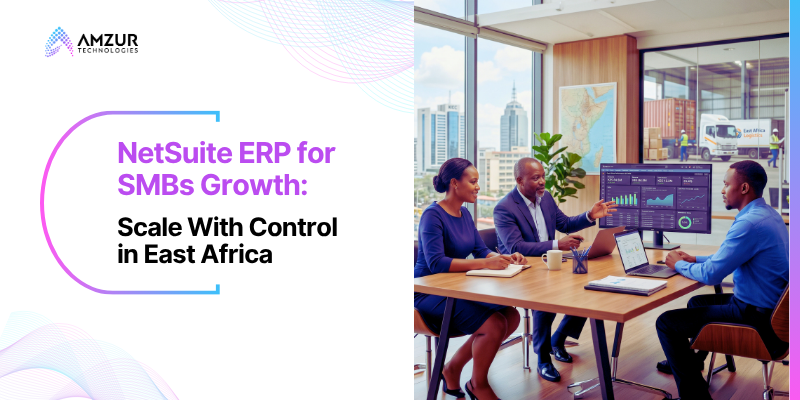
A growing business rarely struggles for lack of opportunity. It struggles because opportunity starts moving faster than control. NetSuite ERP for SMBs helps East African companies scale finance, inventory, and compliance without losing visibility or governance.
A CFO may see revenue rising across new branches, entities, or markets, yet still wait days for clean reports. A COO may see demand increasing, yet lack real-time visibility into inventory, procurement, fulfillment, and cash movement. A finance head may know the business is expanding, yet still rely on spreadsheets to reconcile intercompany transactions, manage local tax workflows, process supplier payments, and track branch-level performance.
That is the point where ERP stops being a software decision and becomes an operating model decision.
For East African SMBs, especially companies scaling across Kenya, Uganda, Tanzania, Rwanda, and wider African markets, the real question is not whether to digitize.
The question is: which cloud ERP foundation can help the business grow without losing financial discipline, compliance readiness, and operational visibility?
This is where NetSuite ERP for SMBs deserves serious consideration, not as a product shortcut, but as a framework for building control into growth.
Explore our NetSuite ERP services for Kenyan businesses.
Why do growth-stage SMBs outgrow disconnected systems?
Growth exposes every weak process.
A single-entity business can survive with accounting software, spreadsheets, manual approvals, and disconnected inventory records for some time. But once the business adds entities, locations, warehouses, tax registrations, payment channels, or regional subsidiaries, those tools begin to break the rhythm of decision-making.
The problem usually appears in familiar ways: delayed financial close, inconsistent tax treatment, poor inventory visibility, duplicated supplier records, unclear branch profitability, manual payment reconciliation, and reports that leadership does not fully trust.
For CFOs and COOs, this creates a dangerous gap. The business appears to grow, but the control layer does not grow with it. That is why ERP for Kenyan businesses should not only record transactions. It should help leaders control complexity.
A solution like NetSuite ERP for SMBs becomes relevant when leadership needs one connected system to manage finance, operations, approvals, reporting, entities, currencies, and integrations from a single cloud foundation.
What are the signs your SMB has outgrown its current systems?
A growing SMB may not need a new ERP simply because it is growing. It needs a stronger ERP foundation when growth starts creating control gaps.
The warning signs usually appear in the same places:
Month-end close depends on spreadsheets from multiple teams
Entity-level reports do not match group-level numbers
Finance teams manually reconcile M-Pesa, bank, POS, and invoice records
Inventory visibility changes by branch, warehouse, or system
Local entities follow different approval rules
Intercompany transactions need manual tracking
Tax and compliance workflows sit outside core finance operations
Leadership cannot trust reports without manual validation
These symptoms do not mean the business has failed. They mean the operating model has become more complex than the current systems can control.
Why does multi-entity growth create financial blind spots?
Multi-entity growth creates a simple but painful challenge: each entity must operate locally, while leadership needs one group-level view. A Kenya-based business expanding into Uganda or Tanzania may need local currency records, local tax processes, country-specific reporting, separate legal entities, and local teams. At the same time, the CFO still needs consolidated visibility into revenue, margin, cash flow, liabilities, and performance.
NetSuite OneWorld supports global, multi-subsidiary organizations by allowing a single NetSuite account to manage records and transactions across multiple subsidiaries, tax jurisdictions, and currencies. Each subsidiary can have its own legal entity structure, tax nexus, and base currency, while subsidiary data can roll up into consolidated parent-level reporting.(Source – OneWorld Overview)
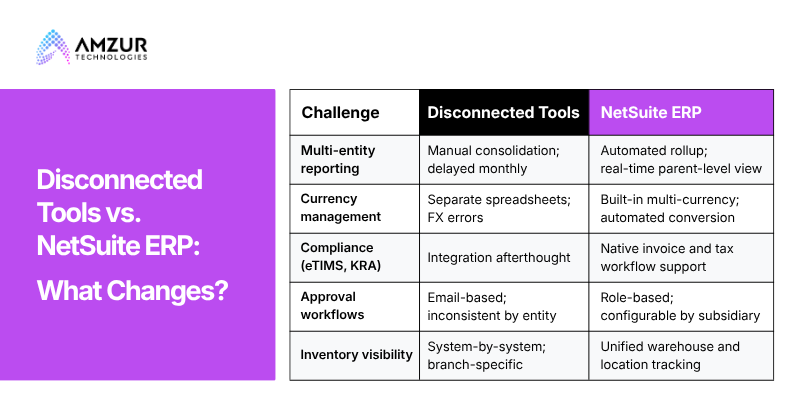
This matters because consolidation should not become a monthly spreadsheet project. It should become a controlled financial process. For East African companies, NetSuite ERP For SMBs can help leadership move from entity-by-entity reporting to group-wide financial clarity.
Disconnected Tools vs. NetSuite ERP: What Changes?
How should CFOs think about currencies, reporting, and consolidation?
Currency complexity often starts quietly.
A business may sell in KES, buy in USD, pay suppliers in UGX, report group performance in another currency, and manage local statutory reporting separately. Over time, this creates FX visibility gaps, reconciliation effort, and reporting delays.
NetSuite OneWorld requires the Multiple Currencies feature, and each subsidiary can have a separate base currency. Transactions can also use currencies defined on customer or vendor records. NetSuite also supports consolidated reporting across subsidiaries where applicable, including reporting that rolls child subsidiaries into a selected parent subsidiary.
For CFOs, the outcome matters more than the feature: faster visibility into regional performance, cleaner consolidation, fewer spreadsheet dependencies, and better confidence in board reporting.
That is why NetSuite ERP For SMBs fits companies that need more than bookkeeping. It supports the finance discipline required to scale across countries, entities, and operating models.
Why does compliance need to sit inside ERP workflows?
Compliance in Kenya and East Africa increasingly starts at the transaction level.
In Kenya, KRA states that all persons engaged in business must onboard eTIMS and issue electronic tax invoices. KRA also states that business expenses must be supported by electronic tax invoices to support expense claims. For companies with existing ERP or invoicing systems, KRA provides system-to-system eTIMS integration through VSCU and OSCU API routes.
This changes the ERP conversation. Finance leaders cannot treat compliance as an after-the-fact filing task. The invoice, customer data, tax treatment, approval workflow, and audit trail must all work together before reporting begins. For ERP for Kenya SMBs, this means the system must support structured tax data, integration readiness, invoice traceability, role-based access, and exception handling.
How can COOs gain control across inventory, procurement, and operations?
COOs face a different version of the same problem. They do not only need finance reports. They need operating visibility.
A distributor wants to know which warehouse holds stock, which entity owns it, which customer order needs it, and how quickly the team can fulfill demand. A manufacturer wants procurement, production, inventory valuation, and sales orders to connect without manual rework. A retailer wants POS, branch sales, payments, inventory, and finance records to tell the same story.
When systems remain disconnected, operations may look busy but not controlled.
Cloud ERP for Kenyan businesses should help connect purchasing, inventory, fulfillment, warehouse activity, invoices, payments, and reporting. That is where NetSuite ERP for East African SMBs can support leaders who want entity-level visibility without giving up group-level control.
The business outcome is practical: fewer stock surprises, better working capital visibility, stronger purchasing discipline, and more reliable reporting across branches and entities.
How can Kenyan businesses become eTIMS-compliant ready? Guide for CFOs and COOs
How should leaders manage local autonomy without losing group control?
Regional businesses need both freedom and discipline. Local teams need enough access to run daily operations. Group finance needs enough control to protect reporting, approvals, cash, compliance, and governance. If the system gives everyone too much access, risk increases. If it centralizes everything too tightly, local teams slow down.
NetSuite OneWorld allows role access restrictions by subsidiary. Roles can be set to access all subsidiaries, active subsidiaries, the user’s own subsidiary, or selected subsidiaries. For CFOs and COOs, that feature solves a real governance challenge. It allows leadership to design access around responsibility. A local finance user can work within their entity. A group controller can see consolidated information. A regional COO can review operational performance without exposing every sensitive finance record.
This is one reason NetSuite ERP For SMBs can support growth-stage companies that need governance without excessive bureaucracy.
Why do integrations matter more in East African ERP decisions?
No ERP operates in isolation, especially in East Africa. Businesses often need to connect ERP with eTIMS, M-Pesa, banks, POS systems, ecommerce platforms, logistics tools, payroll systems, tax platforms, and regional payment infrastructure. Integration quality determines whether the ERP becomes a source of truth or another isolated system.
NetSuite SuiteTalk REST web services provide a REST-based integration channel for interacting with NetSuite records, supporting record operations, metadata access, and queries. SuiteFlow also supports custom workflows for business processes, including approvals, record actions, and process automation.
This matters for decision-makers comparing the best cloud ERP for Kenyan businesses. The right question is not, “Can this ERP integrate?” The better question is, “Can this ERP support the process we need after integration?”
For Kenya businesses, that may mean reconciling invoices with eTIMS, matching M-Pesa and bank receipts, validating supplier bills, routing approvals by entity, or producing dashboards by country, branch, and business unit.
How does real-time reporting change decision-making?
Many SMB leaders don’t struggle with a shortage of reports; rather, they grapple with the challenge of obtaining reliable and trustworthy reports. A CFO may receive revenue data from one tool, payment data from another, inventory data from a spreadsheet, and tax data from a portal. By the time the reports align, the decision window may already close.
NetSuite SuiteAnalytics Workbook can use real-time data, so users see the most current information in datasets, workbooks, and analytics portlets. For finance teams, this helps move reporting from rear-view analysis to active management. For COOs, it helps connect operational movement to financial impact. For owners and boards, it improves confidence in the numbers.
That is why NetSuite ERP for SMBs often appeals to companies searching for the best cloud ERP for finance teams. The value sits in faster, cleaner, more connected visibility.
East African ERP Market & Compliance Context
Understanding the broader regional landscape helps leadership evaluate both the timing of digital transformation and the expected return on investment:
90%+ of Kenyan taxable businesses are now required to comply with the KRA's eTIMS mandate (Kenya Revenue Authority, 2023).
68% of SMBs in emerging markets identify multi-entity financial visibility as their primary operational priority (Gartner 2024 ERP Survey).
40% longer month-end close cycles are reported by businesses managing three or more entities without a unified ERP foundation (Amzur internal data, 2024).
6 out of 10 East African SMBs continue to rely on manual spreadsheets for group-level consolidation (Regional market interviews, 2024).
Who This Guide Is For
This framework is designed for leaders navigating the complexities of regional growth:
Finance leaders (CFOs, Finance Managers) managing multiple entities, currencies, or tax jurisdictions across East Africa.
Operations leaders (COOs, Operations Managers) seeking to eliminate visibility gaps in branches, inventory, and procurement.
Business owners scaling regionally who require a connected ERP foundation instead of fragmented point solutions.
Compliance and finance teams in Kenya impacted by eTIMS, KRA mandates, or multi-jurisdictional reporting requirements.
Companies with 50–500 employees experiencing growth that has outpaced the capabilities of basic accounting software.
NetSuite ERP serves as the strategic operating model for businesses that have outgrown single-entity tools and wish to avoid the operational debt of a fragmented, hard-to-maintain ecosystem.
When is NetSuite the right fit for SMBs in Kenya and East Africa?
NetSuite may not be the right fit for every business. Very small companies with simple accounting needs may not need a comprehensive cloud ERP. A modular entry-level system may serve them well. But the decision changes when the business starts to face complexity: multiple entities, multiple branches, multiple currencies, high transaction volume, compliance pressure, inventory movement, payment reconciliation, or management reporting gaps.
At that point, the business needs more than software. It needs a control architecture. That is where NetSuite ERP For SMBs becomes a serious option for ERP for Kenya businesses and regional companies that want to scale without creating operational debt.
The strongest use case emerges when leadership wants to replace fragmented tools with a single cloud ERP foundation that supports finance, procurement, inventory, reporting, entity management, integrations, and governance.
What is the final decision-making takeaway?
Growth-stage SMBs do not need more disconnected tools. They need clearer control.
For CFOs, the priority is reliable finance data, clean consolidation, compliance readiness, cash visibility, and board confidence. For COOs, the priority is operational discipline across locations, inventory, procurement, fulfillment, and teams. For both, the real value of ERP lies in turning complexity into structured visibility.
NetSuite ERP For SMBs should not be evaluated as a quick software upgrade. It should be evaluated as a long-term operating foundation. For businesses seeking cloud ERP for Kenya businesses, the best decision will come from mapping the company’s growth model first: entities, currencies, compliance workflows, integrations, reporting needs, and governance gaps. Once those are clear, the right ERP choice becomes easier.
The goal is not to choose the most feature-heavy platform. The goal is to choose the system that helps the business grow with fewer blind spots, cleaner controls, and stronger decision-making. That is the real value of NetSuite ERP for SMBs for ambitious East African businesses.
Get in touch with Amzur’s NetSuite experts to evaluate your ERP needs.
Frequently Asked Questions
When should an SMB consider moving from basic accounting software to cloud ERP?
An SMB should consider cloud ERP when finance, inventory, payments, approvals, reporting, and compliance workflows become difficult to manage across branches, entities, or systems. The trigger is not company size alone. It is when leadership starts losing visibility, control, and confidence in the numbers.
Why is NetSuite ERP relevant for growing SMBs in Kenya and East Africa?
NetSuite ERP can help growing SMBs manage finance, inventory, procurement, reporting, multi-entity operations, role-based access, and integrations from one cloud platform. For Kenya and East African businesses, this matters because growth often brings more locations, currencies, tax workflows, payment channels, and reporting complexity.
How does NetSuite support multi-entity business growth?
NetSuite OneWorld supports multiple subsidiaries, entities, currencies, tax jurisdictions, and consolidated reporting from a single ERP environment. This helps CFOs and COOs manage local operations while maintaining group-level financial visibility and control.
Can NetSuite support Kenya-specific compliance needs like eTIMS?
NetSuite can be configured and integrated to support Kenya-specific compliance workflows such as eTIMS-related invoicing, tax reporting, audit trails, and payment reconciliation. However, businesses should validate the right integration route, local requirements, and implementation approach before rollout.
What problems can cloud ERP solve for finance teams?
Cloud ERP can help finance teams reduce manual reconciliations, improve month-end close, consolidate entity-level data, manage approvals, strengthen audit readiness, and create more reliable reporting. For CFOs, the biggest benefit is moving from delayed spreadsheet-based reporting to real-time financial visibility.
Is NetSuite ERP suitable for every SMB?
Not always. A very small business with simple accounting and limited operations may not need a full ERP system yet. NetSuite becomes more relevant when an SMB manages multiple entities, branches, currencies, inventory locations, payment channels, compliance requirements, or reporting gaps that basic systems can no longer control.

Author: Serghino Felix
Sr. Director – of Enterprise Applications
Serghino Felix is a seasoned ERP professional with nearly two decades of experience in the enterprise applications space. Known for connecting strategy with execution, he has built a career around turning complex business challenges into scalable, practical solutions, while keeping people and outcomes at the center of every engagement. His expertise spans delivery leadership, customer partnership, and strengthening enterprise application practices that drive real business transformation.