8 Factors Kenyan Businesses Should Know Before ERP Vendor Selection
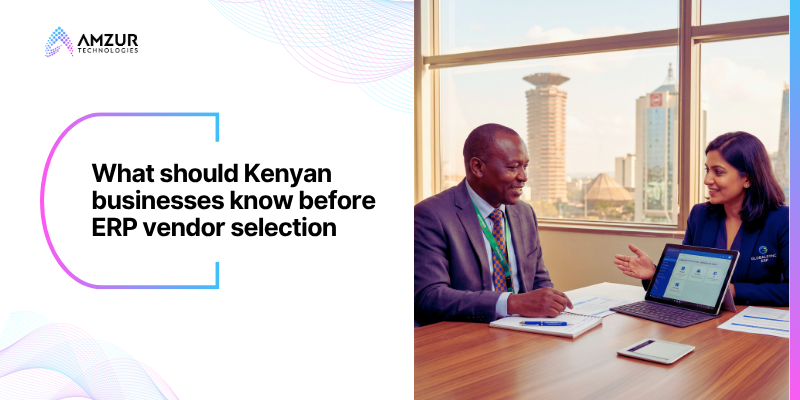
In today’s business environment, compliance is essential. The Kenya Revenue Authority (KRA) now requires all businesses to onboard the electronic Tax Invoice Management System (eTIMS) and issue electronic tax invoices. These invoices are crucial for ensuring that business expenditures are tax-deductible.
As a result, companies must adapt their Enterprise Resource Planning (ERP) systems to support compliant transaction data rather than just internal bookkeeping.
For CFOs, COOs, Finance Heads, and IT leaders, the right question is no longer, “Which ERP has the most features?” The better question is, “Which ERP solutions provider can help us build a compliant, connected, and scalable operating foundation for Kenya?”
That is why ERP vendor selection should start with business risk, financial control, and operational readiness. This blog serves as a resource for organizations in Kenya navigating the process of choosing an ERP vendor that aligns with their expanding operational requirements.
Why has ERP vendor selection changed in Kenya?
ERP vendor selection has changed as Kenya’s business environment has become more digital, compliance-led, and data-driven. ERP systems must support real-time tax invoicing, automated VAT records, secure customer and employee data, and payment reconciliation across banks, POS, and M-Pesa.
KRA provides system-to-system eTIMS integration through VSCU and OSCU for businesses with ERP or invoicing systems. VSCU is suitable for bulk invoicing and not-always-online businesses, while OSCU is suitable for always-online invoicing environments.
KRA’s VAT auto-populated return also uses data from iTax, TIMS, eTIMS, and customs systems. For input VAT claims, invoice transmission, buyer PIN accuracy, and compliance with VAT rules matter.
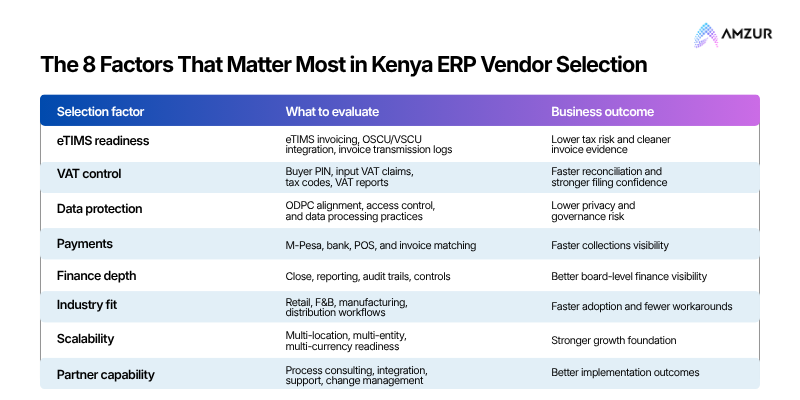
The 8 Factors That Matter Most in Kenya ERP Vendor Selection
A strong Kenya ERP vendor selection guide should focus on outcomes, not only software modules. The ERP partner must prove that the system can support compliance, control, and growth. Here are the top 8 factors to consider:
How should businesses evaluate eTIMS and tax readiness?
When asking how to evaluate an ERP vendor, begin with eTIMS and tax workflows. The vendor should explain how invoices will be generated, transmitted, validated, corrected, and reconciled.
Ask these specific questions during the demo:
- Can the ERP support eTIMS-ready invoicing (accurate item descriptions, tax codes, calculations)?
- Can it integrate with KRA through OSCU or VSCU, or both?
- Can finance teams track failed, delayed, or rejected invoice transmissions in real time?
- Can supplier invoices be validated before payment to ensure they meet KRA requirements?
- Can VAT reports automatically reconcile with KRA-transmitted invoice data?
Why this matters:
eTIMS affects both seller and buyer records. It also affects deductibility, input VAT claims, audit evidence, and supplier governance. Poor invoice control can become a finance risk, not just a tax issue.
The right ERP solutions provider should not give a generic “yes, we can integrate” answer. They should show the workflow, the exception logic, the reporting layer, and the support model. If they cannot walk you through a real-world failed invoice scenario and how the system handles it, that is a red flag.
How should businesses assess data protection and cloud security?
ERP vendor selection must include ODPC and data governance readiness. ERP platforms store customer records, supplier details, employee data, payroll information, tax records, financial data, and payment references.
ODPC defines a data controller as an entity that determines how personal data is used, and a data processor as an entity that processes personal data on behalf of a controller. ODPC also provides mechanisms for data handler registration and breach reporting.[Ref]
A cloud ERP vendor should therefore demonstrate:
Role-based access controls (who can view/edit financial data, payroll, customer records)
Comprehensive audit logs (every transaction logged with timestamp, user, change details)
Secure integration practices (encrypted APIs, token-based authentication, no credential sharing)
Clear data processing responsibilities (who owns what data, who is liable for breaches)
Data retention and deletion controls (automatic archival, GDPR-aligned data minimization
Breach response procedures (notification timelines, incident response team availability)
Cross-border data handling clarity (is data stored in Kenya, region, or global? Legal implications?)
For Kenyan businesses, cloud ERP should not be evaluated only on uptime and convenience. It should be evaluated on governance, accountability, and control. Ask for the vendor’s data processing agreement (DPA) and have your legal team review it before signing.
How does M-Pesa integration affect ERP vendor selection?
M-Pesa is central to payments in Kenya. Safaricom states that M-Pesa APIs allow developers to connect directly to core M-Pesa and support payment use cases such as automated payment receipt processing.
That makes payment integration a critical part of ERP vendor selection. Businesses should ask whether the ERP can connect invoices, customer payments, POS records, bank receipts, and ledger postings without spreadsheet dependency.
For different leaders, the outcome varies:
For CFOs:
Faster cash visibility and improved working capital management
For COOs:
Fewer operational disputes and faster customer account resolution
For finance teams:
Reduced manual reconciliation and improved month-end close discipline
A good ERP vendor should be able to design payment workflows around real business conditions, including partial payments, failed transactions, refunds, branch-level sales, and customer account matching. If the demo glosses over exception handling, ask to see how the system handles a payment that does not match any invoice. That is where vendor maturity shows.
How should industry fit influence ERP vendor selection?
Industry fit often determines whether ERP adoption succeeds. Different industries have fundamentally different operating models:
Retail needs POS, inventory by location, customer promotions, payment integration, and location-level reporting
Manufacturing needs bills of materials (BOMs), production planning, inventory valuation, costing, and quality controls
Wholesale and Distribution need order fulfillment, warehouse visibility, purchasing, credit control, and delivery tracking
That is why ERP vendor selection should test the vendor's industry understanding. The vendor should not only explain the software but also explain the business process.
How to Select an ERP Vendor in Kenya: The 5-Step Process
If you are asking how to select an ERP vendor in Kenya, use a practical five-step approach.
Step 1: Define the Business Outcomes (Week 1)
Clearly state what you want from ERP:
compliance readiness, faster close, inventory visibility, payment reconciliation, audit readiness, or regional growth. Avoid “we need all of it”—prioritize. If compliance is 40% of your decision, cost is 20%, and scalability is 40%, that framework should guide your vendor scorecard.
Step 2: Map the Regulatory and Operational Workflows (Weeks 2–3)
Document your actual workflows:
eTIMS invoicing, VAT reporting, customer-payment-matching, POS integration, payroll, and audit records. Ask each vendor: “Can you support this exact workflow, or will we need to change how we operate?” The right vendor will show confidence; the wrong one will ask you to change.
Step 3: Assess the ERP Platform (Weeks 3–4)
Evaluate:
Finance depth, scalability, integration capability (APIs, webhooks), cloud security, reporting flexibility, and customization approach. Request a live demo with your actual workflows, not a generic sales presentation. Ask about upgrade roadmap and Kenya-specific features.
Step 4: Evaluate the Implementation Partner (Weeks 4–5)
Interview the partner team:
How many Kenya ERP implementations have they completed? Do they have in-house eTIMS and VAT expertise? What is their change management approach? How responsive is their post-go-live support? A strong partner can save you 6 months and KES 1M+ in rework.
Step 5: Test Before Commitment (Weeks 5–6)
Request a proof-of-concept (POC) or extended trial (2–4 weeks) using your actual data and workflows. Do not sign a contract based on demos alone. POCs reveal integration complexity, data migration risks, and user adoption barriers that demos hide.
What should the final ERP decision prove?
The final ERP vendor selection decision should prove that the vendor can help your business operate with more control, not more complexity.
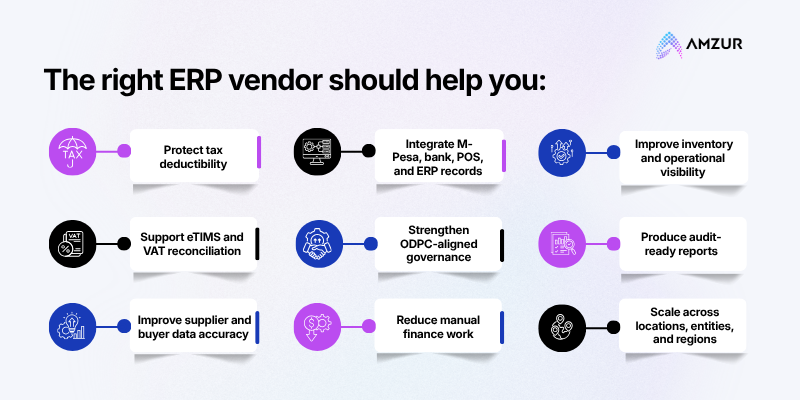
For Kenyan businesses, ERP should no longer be treated as a back-office system. It is the operating backbone for compliance, finance, payments, inventory, reporting, and growth.
A strong ERP vendor selection process protects the business from poor implementation, weak integrations, compliance gaps, and hidden process costs. More importantly, it helps leadership choose an ERP partner that can support where the business is going, not just where it is today.
Ready to Choose the Right ERP Vendor for Your Business?
Are you evaluating ERP vendors based on cost and features alone, or are you focusing on business outcomes, Kenya compliance, and partner capability?
The difference between a great ERP implementation and a costly mistake often comes down to vendor selection. With over 15 years of deep industry expertise in delivering bespoke NetSuite ERP solutions, Amzur is a trusted partner for businesses seeking to modernize their core infrastructure. We specialize in helping organizations across diverse sectors unify their financial operations, optimize inventory management, and streamline critical business processes for maximum efficiency.
Our approach goes beyond software implementation; we focus on driving tangible business outcomes. By leveraging our extensive experience, we empower Kenyan businesses to achieve total operational transparency and long-term scalability.
Whether you are navigating complex regulatory requirements like eTIMS or looking to integrate seamless M-Pesa payment workflows, Amzur provides the technical proficiency and strategic guidance necessary to transform your ERP from a back-office tool into a strategic growth engine.
Connect with our ERP advisory team to gain expert insights into which ERP vendor and implementation partner will best support your business objectives. We’ll help you navigate the 8-factor evaluation, run proof-of-concept pilots, and negotiate favorable terms with vendors.
Let’s find the right solution together, one that scales with your business and protects your compliance.
Frequently Asked Questions
What makes ERP vendor selection different for Kenyan businesses?
Kenya’s regulatory environment now requires ERP systems to support eTIMS invoicing, KRA’s OSCU/VSCU integration, ODPC data protection, and M-Pesa payment reconciliation. These are market-specific requirements that go beyond standard accounting and inventory features. This makes ERP vendor selection a compliance-first decision, not just a software comparison.
Is eTIMS integration mandatory, and how should a vendor prove readiness?
Yes — KRA requires all businesses to issue electronic tax invoices, and expenditure must be supported by eTIMS records to qualify for tax deductibility. A vendor should demonstrate the full invoicing workflow, exception handling for failed transmissions, and VAT reconciliation reporting — not just claim integration capability.
What data protection standards should an ERP vendor meet in Kenya?
Under the ODPC framework, ERP vendors handling personal data must demonstrate role-based access controls, audit logs, data retention policies, and breach response procedures. This matters because ERP systems store sensitive employee, customer, supplier, and financial records. Vendors should be evaluated on governance and accountability, not just uptime.
How important is M-Pesa integration in ERP vendor selection?
Since M-Pesa is central to payments in Kenya, the ERP should automatically match customer payments, POS records, bank receipts, and ledger entries without spreadsheet dependency. The vendor should also handle edge cases like partial payments, refunds, and branch-level sales. This directly improves cash visibility and reduces manual reconciliation work.
How should a business test an ERP vendor before committing?
Request a demo built around your actual workflows, not a generic sales presentation. The vendor should map your specific compliance requirements, demonstrate industry process fit, and show integration capability with your existing payment and banking setup. This is the most reliable way to assess whether the vendor can deliver real business outcomes.

Author: Serghino Felix
Sr. Director – of Enterprise Applications
Serghino Felix is a seasoned ERP professional with nearly two decades of experience in the enterprise applications space. Known for connecting strategy with execution, he has built a career around turning complex business challenges into scalable, practical solutions, while keeping people and outcomes at the center of every engagement. His expertise spans delivery leadership, customer partnership, and strengthening enterprise application practices that drive real business transformation.