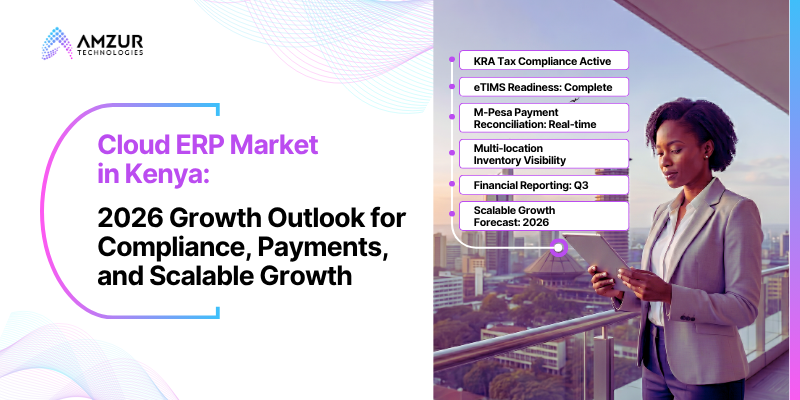
Cloud ERP Market in Kenya: 2026 Growth Outlook for Compliance, Payments, and Scalable Growth
Kenya’s Cloud ERP market is entering a compliance-led growth phase. Businesses are no longer evaluating ERP only as accounting software or a back-office upgrade. They are looking for cloud-based ERP systems that connect finance, tax compliance, M-Pesa, and bank reconciliation, inventory, procurement, reporting, and multi-location operations into one reliable source of truth.
This shift is especially important for growth-stage businesses in Kenya and East Africa. With KRA eTIMS adoption, VAT reconciliation pressure, payment integration complexity, ODPC data governance expectations, and regional expansion needs, Cloud ERP is becoming a strategic control backbone rather than a simple software investment.
This makes Kenya one of the more interesting East African ERP markets because the buying trigger is no longer only “efficiency.” It is now compliance, control, and scalable growth.
Why Kenya's Cloud ERP Market Is Entering a New Growth Phase
The region is no longer treating ERP as a back-office accounting tool or an optional system upgrade. Businesses are now evaluating ERP as a core operating backbone that connects finance, tax compliance, payments, inventory, procurement, reporting, and regional expansion.
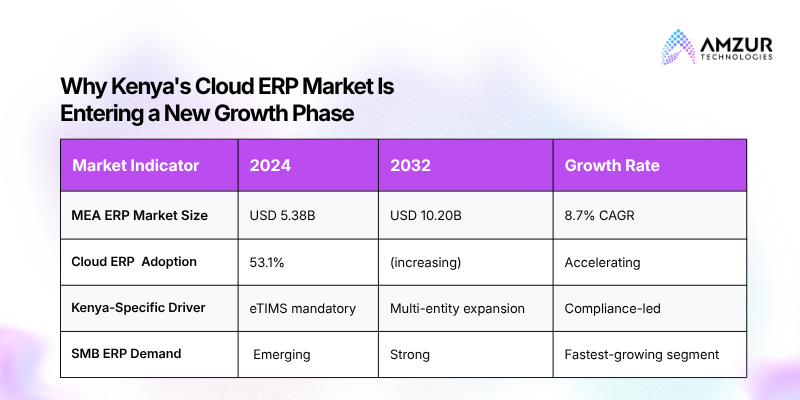
The broader Middle East and Africa ERP software market provides clear evidence of this shift. Fortune Business Insights valued the MEA ERP software market at USD 5.38 billion in 2024 and projects it to reach USD 10.20 billion by 2032, growing at a CAGR of 8.7%. The same report notes that 53.1% of enterprises have already implemented cloud-based ERP solutions, while the rest continue to depend on on-premise ERP systems.
Key Market Statistics
Cloud ERP Is Moving From Back-Office Software to Business Control Infrastructure
The first major shift in Kenya’s Cloud ERP market is the move from infrastructure-heavy, on-premise ERP to cloud-first architecture. Historically, many African businesses delayed ERP modernization because of hardware costs, limited internal IT capacity, implementation risk, and maintenance burden.
Cloud ERP solutions in Kenya reduce these barriers by delivering integrated systems without requiring the same infrastructure investment. 6Wresearch describes Kenya’s Cloud ERP software demand growing around platforms that integrate core functions: finance, HR, supply chain, and customer relationship management. Demand drivers include the need for real-time insights, migration from legacy systems, and business continuity.
This matters because Kenya’s growth-stage businesses are often distributed by design:
Retailers operate multiple branches
Distributors manage warehouses and territories
Manufacturers coordinate procurement, production, inventory, and delivery
Service companies operate through field teams
For these businesses, ERP access cannot depend on one office, one server, or one finance team. Cloud-based ERP software enables multi-location access, reduced IT overhead, remote collaboration, and centralized oversight.
Cloud ERP in Kenya is becoming less about “technology modernization” and more about operating visibility across distributed businesses. This is why the market is accelerating.
What Is Driving Cloud ERP Adoption in Kenya?
1. How Does eTIMS Impact Cloud ERP Adoption in Kenya?
The most important Kenya-specific driver is tax digitization. KRA’s eTIMS ERP integration requirements have changed the role of ERP in business operations. KRA states that all persons engaged in business must onboard eTIMS and issue electronic tax invoices. It also states that, from 1 January 2024, business expenses must be supported by an electronic tax invoice for expense claims.
This changes ERP buying in a fundamental way. In the past, a business could treat tax reporting as a finance department activity performed after transactions were recorded. That model is becoming weaker. KRA eTIMS compliance is now closer to the transaction itself. The invoice, buyer details, tax treatment, inventory movement, payment record, and audit trail must align.
For businesses with ERP or invoicing systems, KRA also provides system-to-system integration through APIs using VSCU and OSCU. VSCU supports system integration between a taxpayer’s invoicing or ERP system and eTIMS and is suitable for bulk invoicing or not-always-online environments. OSCU also supports ERP or invoicing-system integration and is suitable for always-online invoicing environments.
Businesses are no longer asking only whether an ERP can create invoices. They are asking whether it can support defensible tax evidence.
2. Finance teams are driving the next ERP buying cycle
Another signal from the MEA market is the importance of financial management. Fortune Business Insights reports that financial management held the largest market share among ERP business functions in 2024. It also identifies inventory and work order management as an area expected to grow strongly, driven by sectors such as retail, manufacturing, and healthcare.
That aligns closely with Kenya’s buyer reality. CFOs and Finance Heads are under pressure to close books faster, reconcile VAT, track supplier invoices, manage payment visibility, support audits, and deliver reliable reports to leadership. COOs are under pressure to improve inventory accuracy, procurement control, warehouse visibility, fulfillment, and branch-level performance.
This convergence of finance and operations creates one of the strongest Cloud ERP use cases in Kenya: the need for a single system that connects financial control with operational truth.
3. How Does M-Pesa Reconciliation Fit Into Cloud ERP Strategy in Kenya?
Kenya’s Cloud ERP market has payment complexity that many global ERP narratives understate. M-Pesa, banks, POS systems, cards, customer transfers, and branch-level collections all feed into operations simultaneously. If these channels do not reconcile cleanly with invoices and ledgers, finance teams spend excessive time on manual matching.
M-Pesa ERP integration is now a core business requirement, not an add-on. Safaricom’s Daraja platform provides access to Safaricom and M-Pesa APIs, creating the bridge for M-Pesa reconciliation with web and mobile applications. ERP solutions Kenya that support payment integration deliver:
Faster cash visibility
Fewer unapplied receipts
Cleaner customer accounts
Better collections management
More reliable month-end reporting
This is why M-Pesa ERP reconciliation and bank reconciliation ERP are now primary ERP selection criteria for Kenyan businesses, not secondary features.
4. How Is Data Governance Shaping Cloud ERP Decisions in Kenya?
Cloud ERP market growth also depends on trust. Kenya’s Data Protection Act and ODPC’s oversight have made data governance a practical business concern. ODPC’s mandate includes regulating personal data processing, protecting privacy, establishing mechanisms for personal data protection, and providing data subjects with rights and remedies.
This matters because ERP systems process sensitive business and personal data: employee records, payroll, supplier details, customer data, tax identifiers, banking references, contracts, invoices, and operational records.
As more businesses shift to cloud ERP in Kenya, buyers will ask stronger questions about role-based access, audit logs, data retention, hosting, cross-border data processing, user permissions, and breach response.
Industries Creating the Strongest Cloud ERP Demand in Kenya
The Cloud ERP market in Kenya is strongest where transactions, inventory, compliance, and payments create operational pressure. Here’s where adoption is accelerating:
| Industry | Key Challenges | ERP Buying Priority | Expected Impact |
|---|---|---|---|
| Retail & Omnichannel |
Sales speed exceeds reconciliation; fragmented POS and inventory data | Multi-location finance visibility, real-time payment reconciliation | Faster month-end close, accurate branch profitability |
| Wholesale & Distribution |
Inventory grows faster than control; receivables aging untracked | Stock visibility, procurement control, and credit management | Improved cash flow, fewer write-offs |
| Manufacturing | Complex BOM costing, production planning accuracy, supplier control | Procurement visibility, production costing, inventory valuation | Better margin prediction, on-time delivery |
| Food & Beverages | Batch traceability, expiry management, supplier compliance | Batch tracking, expiry alerts, supplier record control | Reduced waste, faster recalls, cleaner recalls |
| Healthcare & Pharma |
Regulated inventory, product traceability, compliance audits | Audit trail completeness, regulated procurement, role-based access | Faster regulatory audits, reduced compliance risk |
Cloud ERP Solutions Adoption Barriers In The African Market:
ERP implementations are notoriously high-stakes initiatives. Industry data indicates that approximately 50% to 70% of ERP implementations in emerging markets fail to achieve their intended goals or experience severe budget overruns.
The Primary East African Failure Points
1. Lack of Data Hygiene
Organizations often migrate raw, “dirty data” from legacy spreadsheets directly into the new ERP database, corrupting financial reporting and operational trust from day one.
2. Over-Customization:
Attempting to force the modern ERP system to replicate inefficient, paper-based legacy workflows creates massive technical debt, delaying implementation timelines and complicating future system upgrades.
3. Poor Change Management
Treating an ERP project purely as a technical IT upgrade rather than a complete business transformation. Failing to engage actual end-users in the process leads to internal resistance, with staff quietly reverting to spreadsheets.
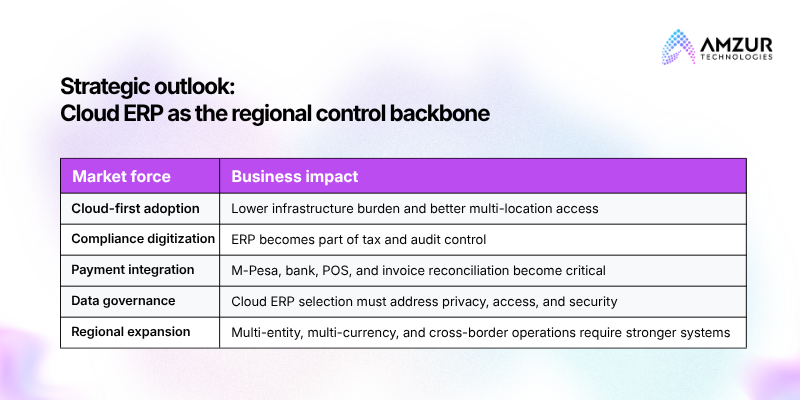
Strategic outlook: Cloud ERP as the regional control backbone
The next phase of Kenya and East Africa’s Cloud ERP market will be shaped by five forces:
Cloud ERP Risk-Reversal Framework for Kenyan CFOs and COOs
1. Process Discovery and Data Cleansing
Conduct a thorough assessment of current workflows and cleanse legacy databases before any migration begins.
2. Enforce a “Clean Core” Strategy:
Prioritize standard, out-of-the-box configurations over custom code alterations. Standardizing operations minimizes technical complexity and ensures seamless security patching.
3. Embed Change Management and Training Early
Appoint internal subject-matter experts from finance, operations, and HR as “system champions”. Involve them in the initial design and training to build trust and accelerate user adoption.
4. Rigorous User Acceptance Testing (UAT):
Avoid rushing the testing phase. Utilize structured test management tools (such as TestMonitor) to guide end-users through real-world scenarios, verifying eTIMS and payment integrations before permanently decommissioning legacy systems.
The strategic conclusion is straightforward: Cloud ERP is becoming the control backbone for growth-stage businesses in Kenya and East Africa.
For ERP providers, the opportunity is significant, but the messaging must mature. Generic claims about automation, efficiency, or digital transformation will not be enough. Buyers need evidence that ERP can solve specific operating problems: eTIMS readiness, VAT visibility, M-Pesa reconciliation, inventory control, audit trails, reporting accuracy, and multi-entity growth.
For businesses, the recommendation is equally clear. Do not evaluate Cloud ERP only by license cost or module count. Evaluate it by the quality of control it creates. The best ERP decision will be the one that helps leadership answer these questions faster:
- Can we trust our financial reports?
- Can we reconcile payments without manual effort?
- Can we prove compliance when audited?
- Can we see inventory across locations?
- Can we scale into new entities or regions without losing control?
- Can finance and operations work from the same version of truth?
That is the real market shift. Kenya and East Africa are not simply adopting Cloud ERP. They are redefining ERP as the operating foundation for compliant, connected, and scalable business growth.
Amzur’s NetSuite ERP Expertise and Bespoke Solutions:
Backed by 15 years of deep industrial experience, Amzur delivers high-impact NetSuite ERP implementations that unify your financial, supply chain, and operational workflows into a single source of truth.
We specialize in helping fast-growing SMBs across diverse sectors bypass legacy inefficiencies and rapidly transition to a highly customizable, cloud-native enterprise system.
Our tailored approach focuses on driving measurable business outcomes—automating complex accounting processes, optimizing inventory, and delivering real-time operational visibility.
As your strategic partner, Amzur doesn’t just deploy software; we build the resilient, scalable digital foundations required to maximize your long-term technology ROI.
Frequently Asked Questions
What is driving the Cloud ERP market in Kenya?
Why is eTIMS important for Cloud ERP adoption in Kenya?
Which industries are most likely to adopt Cloud ERP in Kenya and East Africa?
What challenges can slow Cloud ERP adoption in Kenya?
How should businesses evaluate Cloud ERP solutions in Kenya?

Author: Serghino Felix
Sr. Director – of Enterprise Applications
Serghino Felix is a seasoned ERP professional with nearly two decades of experience in the enterprise applications space. Known for connecting strategy with execution, he has built a career around turning complex business challenges into scalable, practical solutions, while keeping people and outcomes at the center of every engagement. His expertise spans delivery leadership, customer partnership, and strengthening enterprise application practices that drive real business transformation.