NetSuite ERP Optimization: 10 Signs Your ERP Is Costing More Than It’s Saving

Once upon a time, NetSuite implementation was a major milestone. Leadership expected faster reporting, streamlined operations, and better business visibility.
Every day after go-live, teams relied on the system to manage finance, inventory, procurement, and operations. Initially, everything seemed to work as planned.
Then the business changed:
New products were launched.
Additional warehouses came online.
Acquisitions introduced new legal entities.
Finance needed different reports.
Sales expanded into new markets.
Approval processes became more complex.
Employees found quicker ways to get work done using spreadsheets, emails, and manual trackers.
Because NetSuite remained largely unchanged while the business evolved, small inefficiencies accumulated. Month-end close became slower. Reports required manual adjustments. Dashboards lost credibility. Users logged recurring support tickets. Leadership began questioning whether the ERP was still delivering the value it promised.
Until one day, executives realized the issue wasn’t NetSuite itself; it was that the system had stopped evolving with the business.
That’s where NetSuite ERP Optimization becomes essential. The organizations that realize the greatest long-term value from NetSuite aren’t those that simply complete a successful implementation. They’re the ones that continuously optimize the platform to support changing business priorities, improve operational efficiency, and sustain measurable ROI.
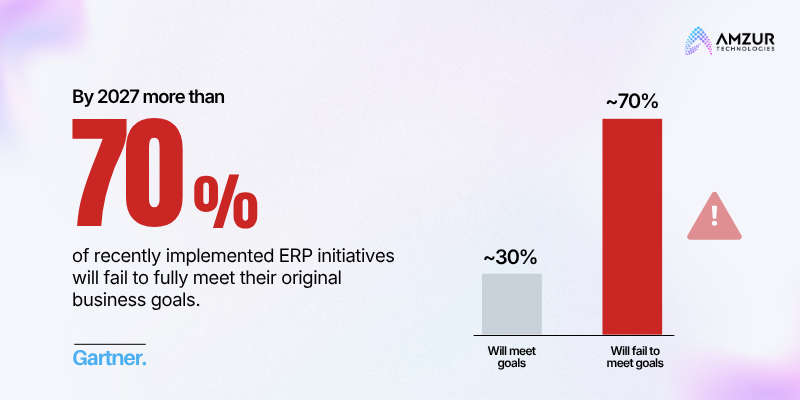
Gartner research predicts that by 2027, more than 70% of recently implemented ERP initiatives will fail to fully meet their original business goals.
Explore our NetSuite Support Services Post Go-Live
Why Is NetSuite ERP Optimization Necessary After Go-Live?
Many organizations treat implementation as the finish line. In reality, it’s the starting point.
Go-live means the system works. Optimization ensures the system continues to work for the business five years later.
As organizations grow, they introduce new subsidiaries, automate additional processes, expand product lines, integrate third-party platforms, and respond to changing compliance requirements. Without continuous optimization, NetSuite gradually reflects yesterday’s business instead of today’s.
This disconnect creates operational friction that often goes unnoticed until it begins affecting productivity, reporting confidence, and financial performance.
10 Signs Your NetSuite ERP Needs Optimization
1. Why Does Finance Still Depend on Excel?
One of the clearest indicators that NetSuite ERP Optimization is overdue is continued reliance on spreadsheets for financial reporting, reconciliations, budgeting, or consolidations.
When finance teams export data into Excel before every management meeting, NetSuite is no longer serving as the organization’s single source of truth.
Business Impact:
Manual reconciliations
Version-control issues
Higher risk of reporting errors
Slower decision-making
Optimization Opportunity:
Redesign saved searches, dashboards, SuiteAnalytics reports, and approval workflows to eliminate manual work and improve confidence in financial data.
2. Why Is Month-End Close Getting Slower Instead of Faster?
A mature ERP should reduce closing time, not increase it.
If finance continues chasing approvals, posting manual journals, and reconciling transactions outside NetSuite, operational complexity has outgrown the original implementation.
Optimization Opportunity:
Review financial workflows, automate approvals, simplify reconciliation processes, and remove unnecessary manual touchpoints.
3. Why Don't Executives Trust ERP Reports?
The most dangerous ERP problem isn’t inaccurate data, it’s leadership losing confidence in it.
If different departments present different numbers for the same KPI, decision-making slows and strategic discussions shift from business performance to debating whose report is correct.
Optimization Opportunity:
Establish standardized reporting, improve KPI governance, and redesign executive dashboards around decision-making rather than data collection.
4. Why Are Employees Creating Workarounds?
Whenever users rely on email chains, spreadsheets, or manual trackers instead of NetSuite, they’re signaling that the ERP no longer supports the way they work.
Optimization Opportunity:
Map current business processes, identify friction points, and streamline workflows to encourage adoption rather than avoidance.
5. Why Does Every Change Require IT Support?
If adding a field, updating a workflow, or modifying an approval process becomes a lengthy IT request, agility suffers.
Businesses evolve quickly. Your ERP should evolve just as easily.
Optimization Opportunity:
Simplify customizations, document configurations, and adopt scalable workflow designs that support ongoing business change.
6. Why Are the Same Support Issues Reappearing?
Recurring tickets related to permissions, workflows, reports, integrations, or saved searches rarely indicate isolated technical problems. They often reveal deeper design or governance issues.
Optimization Opportunity:
Conduct a NetSuite health assessment to identify recurring root causes instead of repeatedly addressing symptoms.
7. Has Your Business Outgrown Its Original NetSuite Design?
Most implementations are designed around the organization at the time of deployment—not the business it becomes three years later.
Growth introduces new entities, channels, warehouses, tax requirements, and approval structures that require continuous refinement.
Optimization Opportunity:
Regularly review business processes against NetSuite configurations to ensure the platform continues supporting operational growth.
8. Are Dashboards Showing Activity Instead of Insight?
Executives don’t need more charts. They need better answers.
If dashboards contain dozens of metrics but fail to answer strategic questions, they’re generating information rather than intelligence.
Optimization Opportunity:
Redesign dashboards around executive KPIs, exceptions, and actionable insights.
9. Have Customizations Become Technical Debt?
Customizations often solve immediate business needs, but unmanaged customizations can slow upgrades, increase maintenance costs, and introduce unnecessary complexity.
Optimization Opportunity:
Review custom scripts, retire obsolete customizations, and adopt standard NetSuite functionality wherever possible.
10. When Was the Last Time You Evaluated Your NetSuite Environment?
Many organizations invest heavily in implementation but never assess the health of the system afterward.
Without periodic reviews, small inefficiencies accumulate until they significantly impact productivity and ERP ROI.
Optimization Opportunity:
Perform regular NetSuite ERP Optimization assessments covering finance, reporting, workflows, integrations, security, automation, and user adoption.
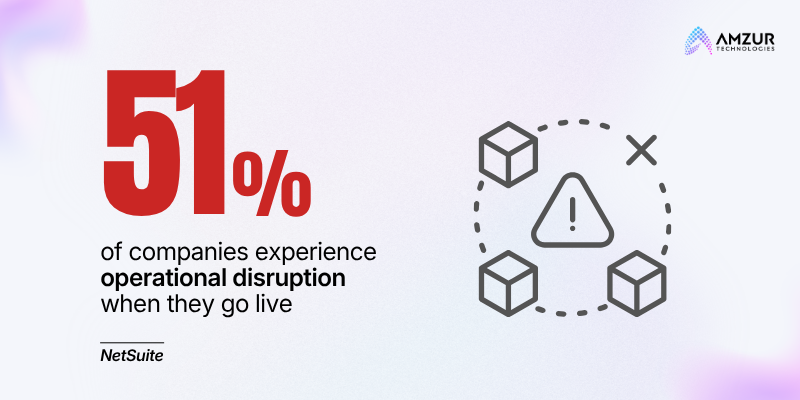
51% of companies experience operational disruption when they go live. – NetSuite
What Is the Cost of Ignoring NetSuite Optimization?
Most NetSuite issues don’t become business-critical overnight. They develop gradually, one manual workaround, one delayed report, one recurring support ticket at a time. Because the impact is incremental, many organizations accept these inefficiencies as “the way things are.”
The real cost isn’t maintaining NetSuite. It’s the business opportunities your organization never captures because your ERP can no longer support the speed, visibility, and agility required to grow.
Ignoring these warning signs affects every strategic initiative, from financial performance to customer experience.
Explore how our NetSuite customization services ensure better ROI.
| Ignored Issue | Business Opportunity Lost |
|---|---|
| Slow month-end close | Delayed financial insights that slow strategic decisions and investor confidence. |
| Spreadsheet-driven reporting | Leadership decisions based on inconsistent or outdated information. |
| Manual finance and operational processes | Higher operating costs and reduced employee productivity. |
| Poor workflow automation | Slower approvals, delayed order processing, and longer customer response times. |
| Recurring support issues | IT resources consumed by recurring fixes instead of innovation. |
| Low user adoption | Reduced return on ERP investment and continued shadow systems. |
| Poor executive dashboards | Missed trends, slower response to market changes, and weaker forecasting. |
| Excessive customizations | Expensive upgrades, greater technical debt, and reduced business agility. |
| Disconnected integrations | Data silos that limit operational visibility across the organization. |
| Lack of continuous optimization | ERP gradually becomes a bottleneck instead of a competitive advantage. |
The Biggest Risk Isn't Operational; It's Strategic
Organizations that postpone NetSuite ERP Optimization rarely stand still. They simply spend more time managing inefficiencies than pursuing growth.
While competitors automate workflows, accelerate financial close, improve forecasting, and gain real-time visibility, businesses operating on an unoptimized ERP often struggle to scale without adding complexity.
The companies that achieve the highest return from NetSuite don’t wait until the system becomes a problem. They optimize continuously, ensuring the ERP evolves alongside their business.
What High-Performing NetSuite Customers Do Differently
The organizations that achieve the highest return on their NetSuite investment don’t wait for problems to become visible. They treat optimization as a continuous business discipline rather than a reactive support activity.
They routinely evaluate reporting effectiveness, streamline workflows, review customizations, strengthen governance, improve user adoption, and align the platform with changing business priorities. As a result, NetSuite continues to support growth instead of becoming a constraint.
Learn more about NetSuite support services for SMBs
A Continuous NetSuite ERP Optimization Framework
NetSuite optimization isn’t a one-time project. It’s an ongoing business discipline that ensures your ERP continues to support growth, improve decision-making, and deliver measurable business value long after implementation.
At Amzur, we follow a continuous optimization framework that aligns technology improvements with evolving business priorities.
1. Assess: Establish the Current State
Begin with a comprehensive evaluation of your NetSuite environment to identify gaps across finance, reporting, operations, automation, integrations, security, and user adoption.
Key questions:
Are business processes still aligned with NetSuite?
Are users relying on manual workarounds?
Where is productivity being lost?
Which reports are no longer trusted?
Outcome: A clear understanding of your optimization priorities.
2. Prioritize: Focus on Business Value First
Not every improvement delivers the same impact. Prioritize initiatives based on measurable business outcomes rather than technical complexity.
Typical priorities include:
Reducing month-end close time
Improving reporting accuracy
Automating repetitive finance tasks
Eliminating spreadsheet dependency
Streamlining approval workflows
Increasing user adoption
Outcome: A roadmap focused on high-impact improvements.
3. Optimize: Improve Processes, Not Just the Platform
Optimization extends beyond configuration changes. It involves rethinking how people, processes, and technology work together.
Typical optimization activities include:
Workflow redesign
Dashboard modernization
SuiteAnalytics optimization
Saved Search rationalization
Role and permission refinement
Automation enhancements
Integration improvements
Customization cleanup
Outcome: A faster, simpler, and more scalable NetSuite environment.
4. Govern: Sustain Long-Term ERP Performance
Business requirements change continuously. Governance ensures your ERP keeps pace.
Leading organizations establish periodic reviews to evaluate:
Business process alignment
Workflow performance
User adoption
Reporting effectiveness
Security and compliance
Technical debt
Integration health
New automation opportunities
Outcome: NetSuite remains aligned with business growth instead of becoming a constraint.
5. Innovate: Turn ERP Into a Competitive Advantage
The most mature organizations don’t stop at optimization, they continuously expand NetSuite’s strategic value.
This includes:
AI-assisted reporting and forecasting
Predictive financial analytics
Intelligent workflow automation
Self-service executive dashboards
Cross-functional process optimization
Continuous KPI refinement
Outcome: NetSuite evolves from a transactional ERP into a strategic platform for innovation and growth.
How Amzur Saved 1,825 Finance Hours For A Retail Client: Success Story
A Florida-based F&B retailer with 15 locations was already using NetSuite, but the finance team still spent 8 hours a day reconciling POS cash, invoices, payments, deposits, and credit memos by hand.
Month-end close was taking 12–15 days.
Amzur fixed the broken workflow between POS and NetSuite.
The result:
Reconciliation time dropped from 8 hours to 3 hours a day
1,825 finance hours recovered per year
Routine days now run with zero manual entries
No new ERP
No extra NetSuite licenses
The issue was not the ERP. It was the workaround around the ERP. Same NetSuite system. Better configuration. Measurable finance impact.
The real question is: how much time is your team losing to a workaround that should not exist?
Learn more about our client’s NetSuite customization story.
NetSuite Implementation Is the Beginning. Optimization Creates Long-Term Business Value.
As reporting requirements change, operations become more complex, and growth introduces new challenges, continuous NetSuite ERP Optimization ensures your ERP remains a strategic asset rather than an operational constraint.
Organizations that invest in ongoing optimization benefit from faster financial close, more reliable reporting, streamlined workflows, higher user adoption, and greater confidence in business decisions. More importantly, they maximize the return on one of their most important technology investments.
With 20 years of enterprise technology experience, 200+ successful NetSuite implementations and optimization engagements, and deep expertise across manufacturing, retail, healthcare, professional services, distribution, nonprofit, and other industries, Amzur helps organizations unlock the full value of NetSuite long after go-live.
Schedule a Free NetSuite Performance Assessment with Amzur. Our experts evaluate your NetSuite environment across finance, reporting, operations, workflows, integrations, automation, governance, and user adoption, then provide a prioritized roadmap to help you maximize business value from your ERP.
Frequently Asked Questions
What is NetSuite ERP Optimization?
NetSuite ERP Optimization is the continuous process of improving your NetSuite environment after implementation to enhance financial reporting, streamline business processes, automate repetitive tasks, improve user adoption, and maximize long-term ERP ROI. Rather than replacing your ERP, optimization ensures it continues to support evolving business requirements.
When should a business consider NetSuite ERP Optimization?
Businesses should consider optimization whenever they notice signs such as slow month-end close, increasing spreadsheet dependency, inaccurate reporting, recurring support issues, inefficient workflows, low user adoption, or operational processes that no longer align with business growth. Many organizations benefit from an annual or biannual NetSuite health assessment.
What are the business benefits of continuous NetSuite ERP Optimization?
Continuous optimization helps organizations reduce month-end close time, improve reporting accuracy, eliminate manual processes, increase user productivity, strengthen governance, accelerate decision-making, improve user adoption, and maximize the return on their NetSuite investment while supporting future business growth.
How often should a NetSuite environment be reviewed?
Most growing organizations should conduct a comprehensive NetSuite optimization review at least once a year or whenever significant business changes occur, such as mergers and acquisitions, expansion into new markets, implementation of new business processes, organizational restructuring, or major NetSuite releases. Regular health assessments help identify improvement opportunities before they impact business performance.

Author: Serghino Felix
Sr. Director – of Enterprise Applications
Serghino Felix is a seasoned ERP professional with nearly two decades of experience in the enterprise applications space. Known for connecting strategy with execution, he has built a career around turning complex business challenges into scalable, practical solutions, while keeping people and outcomes at the center of every engagement. His expertise spans delivery leadership, customer partnership, and strengthening enterprise application practices that drive real business transformation.