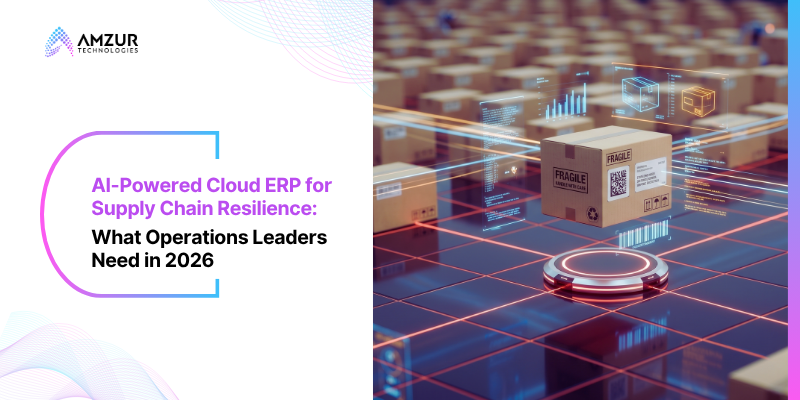
AI-Powered Cloud ERP for Supply Chain Resilience: What Operations Leaders Need in 2026
Supply chain leaders are operating in a fundamentally different environment than they were just a few years ago. Volatility is no longer occasional — it is built into how markets behave. Demand patterns shift faster, supplier reliability can change with little warning, transportation networks remain exposed to disruption, and customer expectations around speed, transparency, and availability continue to rise.
In this climate, resilience has moved from being a strategic goal to becoming an operational necessity.
After two decades of working with businesses that rely on procurement, inventory, warehousing, fulfillment, and supplier networks, we have seen one pattern repeat itself.
The companies that navigate disruption best are not always the largest or the most capital-intensive. They are the ones who can see change early, connect decisions across functions, and act quickly with confidence.
AI-powered cloud ERP is becoming the operational foundation that makes that possible.
Supply Chain in 2026: The Numbers
Understanding the scale of the challenge helps frame why the right technology foundation matters now.
Supply chain disruptions cost businesses an estimated $184 billion annually in lost revenue and recovery costs, with mid-market companies disproportionately impacted due to thinner buffers. (Source: Interos, 2023)
79% of companies with high supply chain visibility achieve above-average revenue growth compared to peers with limited visibility. (Source: Gartner Supply Chain Research)
Cloud ERP adoption in supply chain management is projected to grow at a CAGR of 11–13% through 2027, driven by demand for real-time data and AI-driven planning capabilities.
Companies using AI-driven demand forecasting report inventory cost reductions of 20–30% on average, with improved fill rates and fewer emergency replenishment decisions.
Why Are Supply Chain Leaders Moving to Cloud ERP in 2026?
Many businesses are still trying to manage modern supply chain complexity with systems and processes that were designed for a more stable world. They rely on fragmented tools, delayed reporting, disconnected spreadsheets, and manual coordination between teams.
That approach makes it harder to identify risks early, respond to change quickly, and balance competing priorities such as cost, service levels, sustainability, and working capital.
This is where AI-powered cloud ERP is becoming increasingly valuable. When implemented thoughtfully, it provides organizations with a stronger operational foundation to integrate supply, demand, inventory, procurement, warehousing, and financial data in a single environment.
Connected visibility helps leaders make faster decisions, reduce risk, and improve performance without turning the supply chain into a reactive exercise. The ideas in your source content point to the right priorities, including trend monitoring, inventory optimization, automation, risk mitigation, visibility, KPI tracking, and continuous improvement.
What matters now is how businesses operationalize those priorities in a more intelligent and scalable way.
Learn more about Retail supply chain automation in 2026.
Traditional SCM vs AI-Powered Cloud ERP:
Understanding the practical difference between legacy approaches and a modern cloud ERP foundation is the starting point for any improvement initiative.
| SCM Dimension | Legacy SCM Systems | AI-Powered Cloud ERP |
|---|---|---|
| Inventory Visibility | Delayed, siloed data | Real-time, cross-network view |
| Demand Forecasting | Manual & backward-looking | AI-driven & predictive |
| Risk Detection | Reactive manual reviews | Automated anomaly alerts |
| Replenishment | Static, manual triggers | Dynamic, rules-based automation |
| Data Reporting | Static weekly/monthly reports | Live, role-based dashboards |
| Traceability | Fragmented audit trails | End-to-end connected records |
This is why supply chain resilience increasingly depends on connected intelligence — not just better tools in isolation.
Why supply chain resilience now depends on connected intelligence
Resilience, in practice, comes down to a company’s ability to anticipate change, absorb disruption, and recover without losing control of cost or customer service. That is difficult when the organization cannot clearly see what is happening across its network.
The real challenge is not just collecting data — it is interpreting the right signals fast enough to act. AI-powered cloud ERP helps address this by bringing together data from multiple operational sources and analyzing patterns that would otherwise be easy to miss.
For example, supply chain teams can evaluate sales trends, order velocity, supplier lead times, purchasing behavior, logistics constraints, and external events within a more unified decision framework. That makes the supply chain less dependent on hindsight and more capable of forward-looking action.
In many organizations, resilience improves not because disruptions disappear, but because the business becomes better prepared to respond before those disruptions escalate.
How Does AI-Powered Cloud ERP Improve Inventory Management?
Inventory remains one of the most sensitive pressure points in supply chain operations. Excess inventory ties up capital, increases carrying costs, and can hide deeper planning inefficiencies. Insufficient inventory leads to stockouts, rushed shipping decisions, missed revenue, and declining customer trust. Both situations weaken resilience.
This is where cloud ERP creates a measurable impact. It gives businesses a live view of inventory across receiving, warehousing, fulfillment, and distribution, while AI-driven analytics help teams forecast demand more accurately and adjust inventory decisions based on changing business conditions.
More importantly, better inventory management contributes to both financial and operational sustainability. It reduces unnecessary working capital pressure, lowers waste, improves storage efficiency, and enables more stable service levels.
In other words, resilience is not only about having enough stock. It is about having the right stock, in the right place, at the right time, with a clearer understanding of why those decisions are being made.
Check out how a leading F&B company automated shipment data with NetSuite for accurate inventory management.
What Supply Chain Tasks Can AI-Powered Cloud ERP Automate?
Automation has become a common part of supply chain conversations, but its value depends on how it is applied. Good automation removes repetitive tasks, reduces manual error, and accelerates decisions that are currently slowed by fragmented workflows. Poor automation simply speeds up inefficient processes.
In practical terms, AI-powered cloud ERP can automate replenishment triggers, order processing, approval routing, warehouse activity, supplier communication, and exception handling. This does not eliminate the need for human judgment. Rather, it gives supply chain professionals more time to focus on strategic coordination, supplier relationships, and problem-solving.
Operational leaders cannot afford to have their best people spending large portions of their day chasing updates, correcting avoidable errors, or reconciling information across disconnected systems. Automation is most powerful when it helps teams spend less time managing friction and more time improving outcomes.
Explore our ERP consulting services for SMBs and growth-stage businesses in the USA.
Data Quality Is the Foundation of Supply Chain Risk Mitigation
Risk management in the supply chain begins with visibility, but it depends on data quality. If supplier performance data is inconsistent, if purchasing data is outdated, or if logistics and inventory information are not aligned, even experienced leaders will struggle to identify risk accurately.
A connected cloud ERP platform helps businesses move away from siloed reporting and toward a shared operational record that supports better sourcing, planning, and supplier oversight. AI adds another layer by helping detect anomalies, forecast disruptions, and identify patterns that require earlier intervention.
For businesses focused on sustainability, this also creates broader strategic value. Reliable data supports traceability, more responsible sourcing practices, improved compliance, and stronger stakeholder confidence. Resilience and sustainability increasingly depend on the same operational discipline.
How Does Supply Chain Visibility Translate Into Better Decisions?
The more a business understands what is happening across its supply network, the more options it has when disruption occurs. Yet many companies still have limited visibility beyond direct suppliers. That makes it difficult to anticipate upstream constraints, assess exposure, and coordinate with confidence.
Cloud ERP helps enable better transparency by connecting procurement, inventory, supplier, warehouse, and fulfillment data in one ecosystem. AI-powered analysis then helps turn visibility into action by highlighting emerging issues, predicting likely disruptions, and giving teams clearer insight into supplier and customer behavior.
Visibility is valuable, but visibility with context is what improves resilience.
Which Supply Chain KPIs Matter Most and How Should You Track Them?
Tracking supply chain KPIs is necessary, but metrics only matter when they influence better decisions. Inventory turnover, cash-to-cash cycle time, fill rate, perfect order performance, and supplier reliability are all useful indicators. The problem is that many businesses still review them too late or in isolation.
With AI-powered cloud ERP, companies can move beyond static reporting and toward more dynamic performance management. Leaders can see how one decision influences another, whether a cost improvement is affecting service quality, or whether inventory optimization is creating fulfillment risk elsewhere in the network.
This is especially valuable in complex environments where tradeoffs are constant. Strong KPI management should not only reveal what happened. It should help leaders decide what to do next.
Continuous improvement is what sustains long-term SCM Resilience
A resilient supply chain is not created through one technology project or one process redesign. It is built through continuous improvement. Market conditions change, supplier networks evolve, customer expectations shift, and digital capabilities advance. Businesses that treat supply chain improvement as a one-time initiative often fall behind because they are solving yesterday’s problems with yesterday’s assumptions.
AI-powered cloud ERP supports this by giving leadership teams continuous access to operational data, better scenario visibility, and stronger cross-functional alignment. It also makes it easier to incorporate frontline insights, supplier feedback, and market signals into ongoing improvements.
Over time, this creates something more valuable than efficiency alone. It creates adaptability. And adaptability is what allows supply chains to remain resilient, sustainable, and successful over the long term.
Conclusion: Build a Supply Chain That Stays Resilient in 2026
A resilient supply chain depends on more than visibility alone. It requires connected planning, real-time inventory insight, smarter procurement, better fulfillment coordination, and stronger financial control across the business.
That is where NetSuite makes a meaningful difference. As a unified cloud ERP platform, NetSuite helps organizations streamline supply chain operations by connecting inventory, purchasing, warehousing, order management, demand planning, and finance in one system.
At Amzur, we bring 20+ years of ERP implementation and business modernization experience, with a strong track record of helping organizations implement, optimize, and extend NetSuite around real operational goals. From improving inventory accuracy and fulfillment workflows to enabling better reporting, automation, and cross-functional visibility, our team helps businesses turn NetSuite into a practical foundation for SCM optimization and long-term growth.
Talk to Amzur’s NetSuite supply chain team to explore how AI-powered cloud ERP can help optimize your operations for resilience, agility, and better business performance.
Frequently Asked Questions
What is AI-powered cloud ERP and how does it apply to supply chain management?
AI-powered cloud ERP combines cloud infrastructure with artificial intelligence to connect supply chain, finance, inventory, procurement, and fulfillment operations in a single system. Unlike traditional ERP, it continuously analyzes operational data to surface trends, flag anomalies, and support faster decisions. Platforms like NetSuite are built on this model, giving mid-market businesses real-time visibility and embedded intelligence across every supply chain function.
How does AI-powered cloud ERP improve supply chain resilience?
AI-powered cloud ERP replaces disconnected, delayed reporting with real-time visibility and forward-looking analytics — so businesses can detect disruptions earlier and respond before they escalate. When supply, demand, inventory, and supplier data all live in one environment, teams make faster, more confident decisions across procurement, fulfillment, and inventory. Companies with high supply chain visibility are significantly more likely to achieve above-average revenue growth than peers operating with limited data connectivity.
What supply chain processes can AI-powered cloud ERP automate?
AI-powered cloud ERP can automate replenishment triggers, purchase order generation, approval routing, exception alerts, warehouse task assignment, supplier communication, and invoice matching. The goal is not to remove human judgment — it is to free operations professionals from administrative friction so they can focus on strategic coordination and continuous improvement.
How long does it take to implement AI-powered cloud ERP for supply chain operations?
For mid-market businesses implementing NetSuite across supply chain, procurement, inventory, and finance, a typical project runs three to six months. Narrower implementations focused on inventory and order management can go live in eight to twelve weeks. Amzur’s methodology structures each phase — discovery, configuration, testing, training, and go-live — to reduce risk and keep timelines predictable.
What is the ROI of AI-powered cloud ERP for supply chain businesses?
ROI typically comes from three areas: reduced inventory carrying costs through better forecasting, lower manual processing costs through automation, and improved working capital efficiency. On the service side, businesses see higher fill rates, fewer emergency shipping decisions, and more reliable order performance. The ability to detect supplier issues and respond faster to disruptions also significantly reduces the financial impact of events that would otherwise require costly recovery.
How is AI-powered cloud ERP different from traditional ERP or standalone supply chain software?
Traditional ERP provides historical reporting and often requires separate tools for different supply chain functions. AI-powered cloud ERP is built on a unified data model where supply chain, finance, inventory, and procurement are connected by design — with demand forecasting, anomaly detection, and exception handling embedded into workflows. This makes the system more adaptive and reduces the manual effort required to maintain accuracy and cross-functional alignment.

Author: Serghino Felix
Sr. Director – of Enterprise Applications
Serghino Felix is a seasoned ERP professional with nearly two decades of experience in the enterprise applications space. Known for connecting strategy with execution, he has built a career around turning complex business challenges into scalable, practical solutions, while keeping people and outcomes at the center of every engagement. His expertise spans delivery leadership, customer partnership, and strengthening enterprise application practices that drive real business transformation.