Tax Compliance in Kenya: Why Your Spreadsheets Are the Real Audit Risk

Imagine an email lands in your Inbox early morning: a notice of audit from the Kenya Revenue Authority. Three years of transactions, dozens of invoices, and a filing history built on spreadsheets and manual journal entries, all of it about to be scrutinized.
For a growing SME, that moment isn’t just stressful. It’s existential.
Because the real question isn’t whether the business paid its taxes in good faith; it’s whether the business can prove it — fast, accurately, and without weeks of reconstruction.
This is the reality for thousands of Kenyan businesses today. Tax compliance in Kenya has quietly become one of the biggest threats to SME growth, not because owners are careless, but because the systems behind their numbers were never built to withstand this level of scrutiny.
It’s not a compliance problem. It’s a data problem wearing a compliance costume.
Why Has Tax Compliance in Kenya Become a Growth Risk?
Tax compliance in Kenya has become more demanding for a specific structural reason: the rules keep changing, and the systems most SMEs rely on don’t keep pace.
Two forces are converging on business owners at once:
Regulatory volatility
Kenya’s Finance Bill changes frequently, altering rates, thresholds, and filing requirements with little runway for businesses to adapt.
Intensified enforcement
As the government pushes harder to close the revenue gap, audit frequency has risen sharply — putting more businesses under direct scrutiny than ever before.
Underneath both forces sit three recurring failures that determine whether a business survives an audit or gets buried by one:
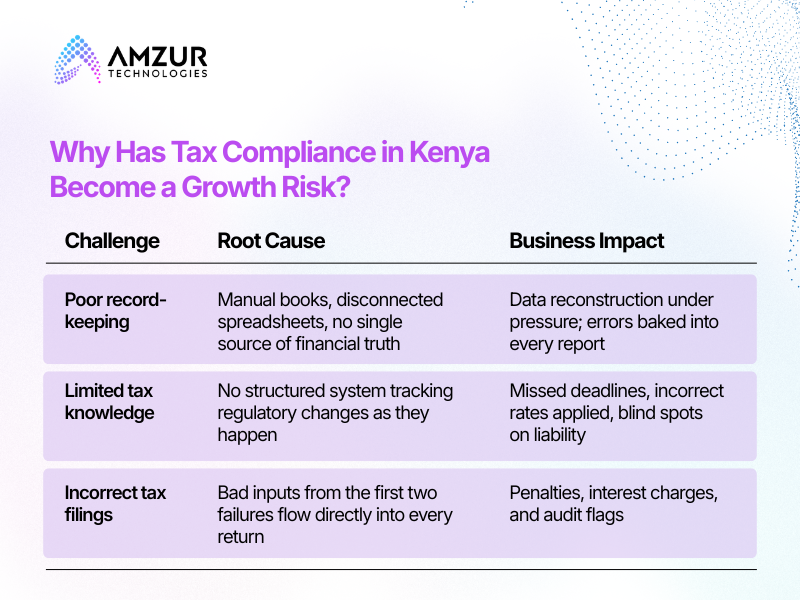
* Notice the sequence. It’s not three separate problems; it’s one broken chain.
Fix the record-keeping, and the knowledge and filing issues shrink dramatically. That’s the insight most compliance conversations miss.
KRA steps up crackdown on tax evasion with digital reforms
This shift is already underway. In a recent meeting with the Kenya Private Sector Alliance (KEPSA), KRA Commissioner General Adan Mohammed confirmed the agency’s plan to widen the tax net and level the playing field between compliant and non-compliant businesses.
KRA is integrating its customs and iTax systems to automate transaction verification and reduce manual compliance gaps, while also working to cut VAT refund processing from weeks to under ten minutes.
For businesses, the message is clear: manual, disconnected records won’t keep pace with an increasingly automated, data-driven tax authority.
The businesses that adapt their own systems now will be the ones positioned to benefit from faster refunds and fewer disputes, not caught off guard by them.
Learn more about KRA eTIMS integration significance.
The Real Cost of Getting Compliance Wrong In Kenya
Ignoring the demands of tax compliance in Kenya doesn’t just risk a fine. It quietly caps how big a business can become.
Direct financial loss
Penalties and interest on incorrect filings erode margins that were hard-won in the first place.
Cash flow shocks
Unplanned tax liabilities discovered during an audit hit working capital when a business can least afford it.
Damaged fundability
Lenders and investors increasingly ask for audit-ready financials before committing capital. A business that can’t produce clean records in real time looks like a risk, regardless of how well it’s actually performing.
A hard ceiling on scale
You cannot expand into new regions, hire aggressively, or take on larger contracts if your finance function is built to survive, not grow.
Founder time held hostage
Every hour spent reconciling spreadsheets for a filing deadline is an hour not spent on customers, product, or strategy.
The businesses that stay small in Kenya aren’t always the ones with bad ideas. Often, they’re the ones whose back office never scaled past the founder’s first Excel sheet.
How Does a Modern Cloud ERP Solve Kenya's Tax Compliance Challenges?
This is where tax compliance in Kenya starts to look less like a threat and more like a solvable systems problem. A modern cloud ERP doesn’t treat compliance as a once-a-quarter fire drill. It treats it as a natural output of how the business already operates, day in and day out.
Here’s the shift:
One system of record
A unified ledger consolidates all transactions, including sales, purchases, payroll entries, and bank reconciliations—to completely eliminate the gaps left by disconnected spreadsheets.
Real-time visibility instead of after-the-fact reconstruction
Financial position and tax exposure are visible today, not discovered during an audit six months from now.
Built-in controls at the point of entry
Errors get caught when a transaction is recorded, not when a filing deadline forces a scramble.
Automatic adaptation to regulatory change
Rules update in the system, not in someone’s memory.
This is the foundation. The platform that executes it best for Kenyan SMEs is Oracle’s NetSuite ERP.
Mapping NetSuite to Kenya's Three Biggest Compliance Gaps
Rather than treating record-keeping, tax knowledge, and filing accuracy as three separate fixes, NetSuite closes all three inside one connected platform, turning tax compliance in Kenya from a recurring scramble into a routine, automated process.
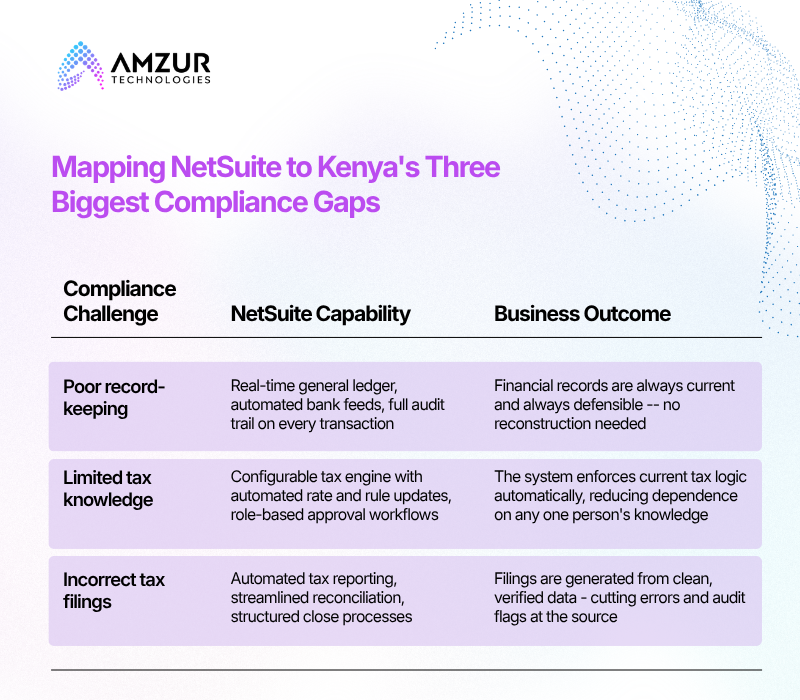
The pattern across all three: NetSuite ERP doesn’t just store financial data. It structures the data so tax compliance in Kenya becomes a built-in property of daily operations, not a separate project layered on top of them.
Learn more about our NetSuite ERP solutions for Kenya SMEs.
What Does Compliance-Ready, Growth-Ready Actually Look Like?
Picture the same audit notice landing on a business running NetSuite ERP. The response isn’t panic; it’s a report, exported in minutes, backed by a full audit trail.
That single shift changes everything downstream:
Finance teams spend their time on planning and growth, not reconstruction.
Leadership walks into lender and investor conversations with clean, real-time financials.
The business can expand into new markets, products, or headcount without fearing what its own books might reveal.
Compliance stops being a source of fear and becomes a quiet, automatic byproduct of good systems.
This is what getting ahead of tax compliance in Kenya actually buys a growing business: not just protection from penalties, but the confidence to scale without looking over its shoulder.
Amzur: A Trusted NetSuite Partner for Kenya's Growing SMEs
Solving tax compliance in Kenya isn’t about bolting on another tool. It’s about rebuilding the financial foundation so compliance happens automatically, as a byproduct of well-structured operations, not as a scramble every filing season.
Amzur Technologies brings 20 years of NetSuite implementation expertise and more than 200 completed projects to this exact challenge.
We help SMEs and growing businesses move off fragmented spreadsheets and onto a single, real-time financial system built for the realities of Kenya’s regulatory environment, one where the Finance Bill changes, audits intensify, and only businesses with clean, connected data stay ahead of both.
If your business is ready to trade audit anxiety for audit readiness, it starts with the right ERP foundation.
Talk to Amzur’s NetSuite team today and find out what a compliance-ready finance function could do for your growth plans.
Frequently Asked Questions
Why is tax compliance in Kenya becoming harder for SMEs?
Frequent Finance Bill changes combined with intensified KRA audit activity have raised the stakes for accuracy. Businesses running manual or disconnected systems struggle to keep pace with both.
What are the most common tax compliance mistakes Kenyan SMEs make?
Poor record-keeping, limited understanding of current tax rules, and incorrect filings are the three most common — and they compound each other, since bad records lead directly to bad returns.
How does a cloud ERP improve tax compliance in Kenya?
A cloud ERP centralizes financial data into one real-time system, so records are always accurate and audit-ready instead of reconstructed under deadline pressure.
Can NetSuite help Kenyan SMEs avoid tax penalties?
Yes. NetSuite’s automated tax engine, real-time ledger, and structured close processes reduce the manual errors that typically trigger penalties, interest, and audit flags.
Why should Kenyan SMEs choose Amzur for NetSuite implementation?
Amzur brings 20 years of NetSuite expertise and more than 200 completed implementations, helping SMEs build compliance-ready finance systems designed to support long-term growth.

Author: Serghino Felix
Sr. Director – of Enterprise Applications
Serghino Felix is a seasoned ERP professional with nearly two decades of experience in the enterprise applications space. Known for connecting strategy with execution, he has built a career around turning complex business challenges into scalable, practical solutions, while keeping people and outcomes at the center of every engagement. His expertise spans delivery leadership, customer partnership, and strengthening enterprise application practices that drive real business transformation.