Why eTIMS Has Changed ERP Buying in Kenya: Guide For CFOs and COOs
For years, ERP buying in Kenya was mostly evaluated through familiar questions: Can the system manage accounting? Can it track inventory? Can it support approvals? Can it produce reports faster than spreadsheets?
Those questions still matter. But eTIMS has changed the conversation entirely.
Kenya’s Electronic Tax Invoice Management System is no longer just a tax invoicing requirement. It is now shaping how businesses prove revenue, validate expenses, claim input VAT, manage suppliers, reconcile payments, and prepare for audits.
KRA states that all persons engaged in business are required to onboard eTIMS and issue electronic tax invoices, including businesses that are not VAT-registered. It also states that, from 1 January 2024, business expenses must be supported by electronic tax invoices to be deductible for income tax purposes.
For CFOs, COOs, and Finance Heads, that changes ERP buying completely.
The question is no longer, “Can our ERP record transactions?”
The question is, “Can our ERP prove every transaction when KRA, auditors, lenders, or the board asks for evidence?”
That is why eTIMS ERP Kenya is becoming a boardroom topic, not just a tax department concern.
How Has eTIMS Changed Tax Compliance for Kenya Businesses?
The biggest shift with eTIMS is that tax compliance now starts at the point of transaction.
In the past, many businesses could clean up records at month-end, reconcile tax data manually, and resolve gaps during filing. That model is becoming risky. KRA’s eTIMS framework is designed to digitise invoice generation and transmission, giving the tax authority structured transaction-level visibility.
Business Daily Africa recently described eTIMS as laying the foundation for faster, data-driven, and potentially automated tax filing in Kenya.
This means invoice data can no longer live in isolated systems. Sales, billing, POS, inventory, customer records, tax codes, buyer PINs, credit notes, and ledger postings must work together from a single connected source.
For a growing business, this creates a direct ERP requirement: a modern ERP system in Kenya must support clean invoice creation, accurate tax treatment, secure approval workflows, and reliable reporting. If these controls are weak, the risk is not only operational it becomes financial and regulatory.
The outcome businesses need is clear: fewer mismatches, fewer manual corrections, faster VAT filing, and stronger audit evidence.
How Does eTIMS Affect Expense Deductibility and Input VAT Claims?
One of the strongest reasons eTIMS has changed ERP buying is its impact on business expenses and VAT claims. .
KRA’s guidance makes it clear that expenses must be supported by valid electronic tax invoices to be deductible. That means an invoice is not just a document. It is tax evidence. If a supplier invoice is missing, wrongly issued, not transmitted, or does not carry the right buyer information, the buyer may face problems claiming the expense or input VAT.
This has serious implications for finance teams. A CFO may approve a supplier payment because the goods were received. But if the supplier invoice is not properly reflected in eTIMS, that transaction can become a tax exposure. Procurement may choose a low-cost supplier, but if that supplier cannot issue compliant invoices, the apparent saving may turn into a hidden cost.
That is why eTIMS compliance in Kenya must be treated as part of supplier governance, not only tax filing. The ERP outcome should be practical: supplier records must be clean, buyer PIN details must be validated, invoices must be traceable, and finance teams must be able to identify exceptions before payment or month-end close.
Why Is VAT Reconciliation in Kenya Now an ERP Data Problem?
VAT filing in Kenya is becoming more dependent on system data quality — and less forgiving of gaps.
KRA’s auto-populated VAT return draws on data from iTax, TIMS, eTIMS, and customs systems. VAT-registered taxpayers must issue or demand electronic tax invoices, transmit invoice details through TIMS/eTIMS, and verify the accuracy of their auto-populated returns. Input VAT claims are only allowed where invoices have been transmitted through TIMS/eTIMS and, for buyer claims, include the buyer PIN. Manual or non-compliant invoices cannot be used.
If internal purchase records do not match KRA’s invoice data, finance teams will spend more time chasing suppliers, correcting master data, downloading reports, and explaining differences. For businesses with multiple branches, POS systems, large supplier bases, or high invoice volumes, the reconciliation load can become significant.
A strong ERP software in Kenya should help finance teams move from reactive correction to proactive control. The outcome is not just filing VAT on time. It is filing with confidence because sales, purchases, tax, and payment data are already aligned.
What Are OSCU and VSCU and Why Do They Matter for ERP Buyers?
For businesses with existing invoicing, POS, or ERP platforms, eTIMS integration is both a technical and operational priority, and the choice of integration route affects system design.
KRA’s system-to-system integration allows businesses to connect their invoicing or ERP systems with eTIMS through APIs. KRA identifies two routes: VSCU, suitable for bulk invoicing and businesses that are not always online, and OSCU, suitable for always-online invoicing environments.
This makes KRA eTIMS integration and OSCU VSCU integration important ERP buying criteria.
A business should ask:
Can the ERP support the required invoice data fields?
Can it manage branch-level invoicing?
Can it handle failed transmission exceptions?
Can it reconcile invoices generated in ERP with invoices visible to KRA?
Can it support credit note control from the original invoicing source?
KRA’s 2025 eTIMS upgrade also introduced more flexibility, allowing taxpayers to use different eTIMS solutions simultaneously and access invoices generated from eTIMS Client, VSCU, OSCU, and the eCitizen portal through the online taxpayer portal.
KRA also noted that credit notes can only be generated from the solution where the original invoice was raised, which makes system design and process control even more important.
For ERP buyers, the implication is simple: integration design is not a technical afterthought. It is part of financial control.
How Does eTIMS Change Supplier Compliance and Procurement Governance?
Many businesses see eTIMS as a sales invoicing issue. That is too narrow – the bigger compliance risk often sits in purchases.
The bigger risk often sits in purchases. If suppliers fail to issue valid eTIMS invoices, the buyer may suffer the consequence through rejected input VAT claims or non-deductible expenses.
This changes procurement governance.
Supplier onboarding should no longer check only price, delivery capability, credit terms, and quality. It must also verify tax invoice readiness. AP teams should not discover invoice compliance issues after month-end, they need system-level visibility before payment approval is granted.
For CFOs and COOs, the outcome is better control over supplier risk. The business protects VAT claims, reduces avoidable tax exposure, and strengthens the quality of financial reporting.
That is why an ERP for Kenyan businesses must connect procurement, supplier master data, invoicing, payment workflows, and tax reporting.
Why Are Disconnected Systems a Compliance Risk Under eTIMS?
Many growing Kenyan businesses still operate with separate tools for billing, accounting, inventory, POS, M-Pesa payments, warehouse operations, and reporting. That may work when transaction volumes are low. It becomes fragile when compliance becomes transaction-led.
The Filing Room has noted that eTIMS makes the electronic version the authoritative tax record, requiring businesses to maintain secure, retrievable digital invoice archives and audit trails. Fragmented storage, poor indexing, and weak backups can undermine audit readiness entirely.
This is where fragmented systems create real exposure.
One platform may hold the sales invoice. Another may hold payment confirmation. A spreadsheet may track inventory. The accounting system may hold VAT entries. The eTIMS portal may show transmitted invoices. When these records do not match, finance teams carry the burden.
The business outcome should be one connected operating layer where invoicing, tax, payments, inventory, procurement, and reporting flow from the same trusted data foundation.
What Should Kenyan CFOs and COOs Demand from an eTIMS-Ready ERP?
eTIMS has raised the standard for ERP buying. CFOs, COOs, and Finance Heads should expect more than accounting automation.
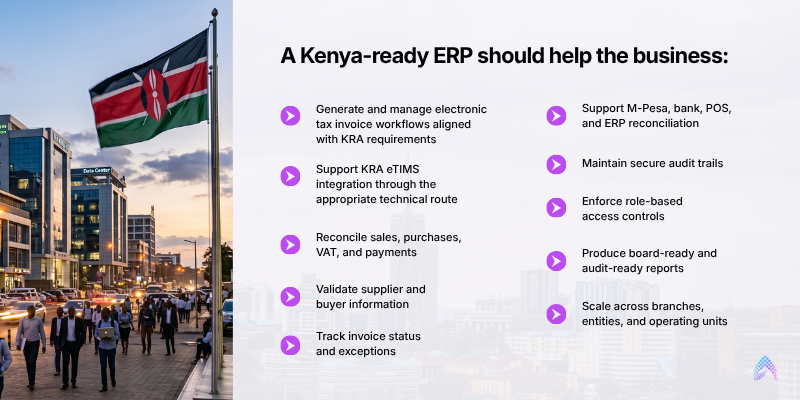
These are not “nice-to-have” features. They are control requirements for a more data-driven tax environment.
A cloud ERP such as NetSuite can help businesses move from manual compliance work to structured finance operations, but only when implemented around the business’s actual workflows.
The goal should not be software deployment. The goal should be measurable control: cleaner records, faster close, stronger tax evidence, better supplier governance, and clearer leadership reporting.
How NetSuite Supports eTIMS ERP Kenya Requirements
As Kenya’s ERP market moves toward cloud-first adoption, businesses evaluating platforms need to ask not just whether a system is cloud-based, but whether it can meet eTIMS-specific compliance requirements at the transaction level.
NetSuite ERP is built as a unified cloud platform connecting finance, procurement, sales, inventory, and reporting in a single system, making it well-suited to the connected data requirements that eTIMS demands. With the right configuration, NetSuite can support eTIMS-ready invoicing workflows, OSCU/VSCU integration, VAT reconciliation, supplier validation, M-Pesa and bank reconciliation, audit-trail management, and role-based access controls.
For businesses operating across multiple entities or planning East African expansion, NetSuite OneWorld enables multi-subsidiary management across different tax jurisdictions and currencies, giving CFOs a single consolidated view of compliance, reporting, and operational performance across the group.
Amzur implements NetSuite around the actual workflows of Kenya-based businesses – not as a generic software deployment, but as a structured finance and compliance foundation. The goal is measurable control: cleaner records, faster close, stronger tax evidence, better supplier governance, and clearer leadership reporting.
eTIMS has changed what a good ERP must prove
eTIMS has changed ERP buying in Kenya because compliance now begins at the transaction level. Every invoice, supplier bill, credit note, VAT claim, payment, and ledger entry must be accurate, traceable, and defensible.
For finance leaders, this is no longer just about avoiding penalties. It is about protecting deductible expenses, preserving input VAT claims, improving audit readiness, and giving the board confidence in the numbers.
Businesses that treat eTIMS as a tax checkbox will continue to fight reconciliation problems. Businesses that treat it as an ERP modernization trigger will build stronger financial control, cleaner data, and better decision-making.
For Kenyan companies looking to modernize, NetSuite offers a trusted cloud ERP foundation that can support evolving compliance expectations, operational complexity, and growth. The right ERP system should not only record transactions. It should help your business prove them.
Want to learn more about how modern Cloud ERP solutions can help your Kenyan business grow seamlessly
Let’s get on a discovery call with our NetSuite ERP expert team.
Frequently Asked Questions
Why has eTIMS changed ERP buying in Kenya?
eTIMS has changed ERP buying because tax compliance now starts at the transaction level. Businesses need ERP systems that can support electronic tax invoicing, VAT reconciliation, supplier invoice validation, audit trails, and reporting aligned with KRA expectations.
Is eTIMS only relevant for VAT-registered businesses?
No. KRA states that all persons engaged in business are required to onboard eTIMS and issue electronic tax invoices, including non-VAT-registered businesses where applicable. This makes eTIMS a wider business compliance issue, not only a VAT matter.
What should CFOs look for in an eTIMS-ready ERP?
CFOs should look for ERP capabilities such as eTIMS-ready invoicing, OSCU/VSCU integration readiness, VAT and input tax reconciliation, supplier invoice validation, buyer PIN accuracy, role-based access, exception reporting, and audit-ready financial records.
How do OSCU and VSCU relate to ERP systems?
OSCU and VSCU are KRA-supported system-to-system integration routes that allow invoicing or ERP systems to connect with eTIMS through APIs. VSCU is suitable for bulk invoicing or not-always-online businesses, while OSCU is suitable for always-online invoicing environments.
How can NetSuite support eTIMS ERP Kenya requirements?
NetSuite can act as a cloud ERP foundation for finance, inventory, procurement, sales, and reporting. With the right configuration and integration approach, it can support eTIMS-related workflows, VAT reconciliation, payment visibility, audit trails, and finance control for growing Kenyan businesses.

Author: Serghino Felix
Sr. Director – of Enterprise Applications
Serghino Felix is a seasoned ERP professional with nearly two decades of experience in the enterprise applications space. Known for connecting strategy with execution, he has built a career around turning complex business challenges into scalable, practical solutions, while keeping people and outcomes at the center of every engagement. His expertise spans delivery leadership, customer partnership, and strengthening enterprise application practices that drive real business transformation.