UAE e-invoicing is an ERP test CFOs cannot outsource in 2026
A practical NetSuite lens on penalties, controls, and readiness
UAE e-invoicing is not simply a new Finance requirement. It is a shift to structured, validated, machine-readable invoice exchange across an ecosystem. The UAE model is decentralised and designed to make invoices traceable digital events, not documents that can be fixed later.
For CFOs, the immediate concern is penalties. The bigger risk is operational: invoice rejections that disrupt receivables, tax mismatches that increase audit exposure, and manual workarounds that raise cost per invoice and slow down close.
This is why e-invoicing becomes an ERP test. If your ERP cannot produce correct invoice data consistently across real scenarios, you do not have a compliance process. You have an exception factory.
What is UAE e-Invoicing Mandate 2026?
The Ministry of Finance – United Arab Emirates describes the UAE e-invoicing model as a Decentralised Continuous Transaction Control and Exchange approach. Suppliers submit invoice data to a UAE-accredited service provider (ASP), which validates the data and, if needed, converts it to the UAE-standard e-invoice XML format. The ecosystem supports exchange and reporting throughout the end-to-end lifecycle.
The policy intent is clear: compliance depends on your ability to generate complete data, transmit it reliably, monitor status, and retain evidence.
What Are the UAE e-Invoicing Penalties for CFOs in 2026?
Cabinet Decision No. 106 of 2025 sets administrative fines for violations linked to the Electronic Invoicing System. These include a recurring monthly penalty tied to failure to implement the system and appoint an ASP on time, per-document penalties for not issuing and transmitting e-invoices or e-credit notes within timelines (with a monthly cap), and daily penalties for late notification of system failures.
The CFO takeaway is that these triggers are repeatable. A manual workaround might “pass” once, but it rarely holds at scale.
The CFO control view: penalty-to-control mapping
Keep your programme crisp by treating each penalty trigger as a control objective, then design ERP behaviours around it.
1) Monthly exposure: delayed implementation or delayed ASP appointment
Control objective: go-live readiness is predictable and governed.
ERP discipline: scenario inventory, master data remediation, integration planning, cutover governance.
2) Per-document exposure: late issuance or late transmission of e-invoices and e-credit notes
Control objective: invoices move from approval to compliant transmission without manual steps.
ERP discipline: workflow-driven approvals, pre-transmission validation, automated retry and exception queues.
Control objective: detect failures quickly, route ownership, and prove timelines.
ERP discipline: alerts, monitoring dashboards, evidence logs, and incident playbooks.
That is the heart of a CFO-ready narrative: penalties reduce when process behaviour becomes reliable.
How NetSuite ERP Supports UAE e-Invoicing Compliance
NetSuite ERP is well-known for its industry and process-specific customisation capabilities to support the ongoing market needs and future demands. Here are the top features of NetSuite ERP that can support the ongoing and evolving UAE e-invoicing needs.
A) ASP connectivity and reliable transmission
SuiteTalk REST Web Services (APIs) provide an integration channel for interacting with NetSuite records via REST-based interfaces.
Why CFOs should care: In a decentralised model that relies on exchange through an ASP ecosystem, transmission reliability is what prevents late submissions and reduces rejection-driven AR disruption.
SuiteTax supports detailed tax breakdowns on transactions, including the Tax Details subtab with tax type, tax code, basis, rate, and amount.
Why CFOs should care: Many rejections and audit issues start as inconsistent tax logic and incomplete master data. When tax detail is standardised at transaction level, you reduce manual adjustments and improve the consistency of invoice tax data before transmission.
SuiteFlow enables workflow automation for business processes such as transaction approval and record management.
Why CFOs should care: Timelines are often missed because approvals are inconsistent, unclear, or overly manual. Workflow-driven approvals reduce bottlenecks and help enforce “issued and sent within timeline” discipline.
Saved Search Email Alerts can trigger alerts when records are created or updated based on defined conditions.
Why CFOs should care: Daily penalties for late failure notification are, in practice, a monitoring test. Alerts for stuck invoices, failed transmissions, missing fields, and growing exception queues shorten response time and lower breach risk.
E) Audit trail and defensible compliance evidence
Transaction Audit Trail and system notes provide a detailed history of transactions, including who entered or modified a transaction and when.
Why CFOs should care: When disputes arise, or when you need to evidence actions during incidents, audit-grade history is the difference between a controlled event and a messy narrative.
Roles and permissions define what users can access and do, and permissions are associated with roles assigned to users.
Why CFOs should care: Uncontrolled changes to customer master data, tax codes, and invoice approvals create compliance drift. Role-based governance supports segregation of duties and reduces the chance that data updates lead to rejections or mismatches.
SuiteAnalytics Workbook lets teams build custom workbooks with datasets, pivot tables, and charts using a consistent analytics data source.
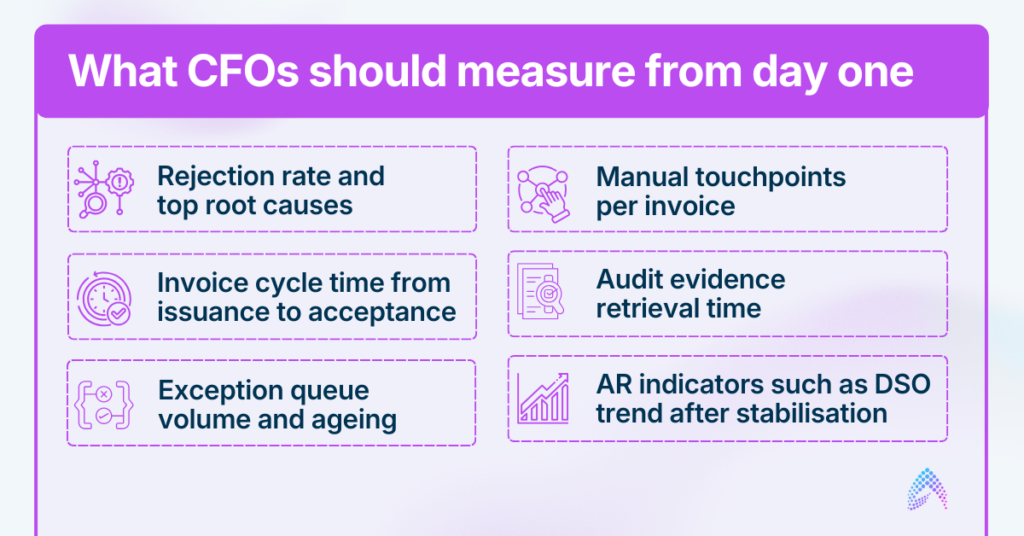
Why CFOs should care: CFOs need operational visibility, not monthly surprises. Workbooks can track acceptance and rejection rates, exception ageing, cycle time from issuance to acceptance, and exposure hotspots by entity or customer segment.
OneWorld subsidiaries and consolidated reporting support a hierarchical subsidiary structure and consolidated reporting across subsidiaries.
Why CFOs should care: Multi-entity UAE groups often suffer from fragmented controls and inconsistent invoicing practices. Consolidated governance reduces compliance fragmentation and makes it easier to standardise invoicing controls across entities.
A CFO-ready implementation path that avoids “rush risk”
Phase 1: Readiness and scope
Define the control objectives: timelines, evidence, monitoring, and ownership.
Phase 2: Design and build
Phase 3: Test and go-live
Phase 4: Stabilise and improve
This approach aligns with the UAE model’s focus on validation, structured exchange, and traceability.
How Amzur helps UAE Businesses In NetSuite ERP Implementation:
If you are running NetSuite in the UAE, the fastest path to confidence is a readiness assessment that connects penalty triggers to ERP controls and real transaction scenarios.
Amzur Technologies typically supports CFO and Finance leaders by translating the UAE e-invoicing model into an execution roadmap: scenario mapping, master data controls, workflow design, integration approach, monitoring, and audit evidence.
If you want a pragmatic starting point, begin with a focused review of your top invoice scenarios, your exception handling model, and your evidence trail readiness, then build outward from there.
Explore our NetSuite ERP implementation and consultation services for UAE businesses.

Director – ERP Advisory & NetSuite Solutions