Financial Record-Keeping for SMEs: Why Clean Books Never Stay Clean

It’s the third week of the month, and your finance team is still trying to establish what happened in the previous one.
Bank statements are being matched against invoices. Someone is chasing a delivery note. A figure in the sales report doesn’t agree with the figure in the ledger, and nobody can say yet which one is right.
This isn’t a crisis. It’s routine. And that’s precisely the problem.
Financial record-keeping for SMEs fails quietly, not dramatically. There’s rarely a single catastrophic error. There’s just a slow accumulation of small gaps that leaves leadership making decisions on numbers nobody fully trusts.
Why Do SME Financial Records Break Down?
The root issue behind weak financial record-keeping for SMEs isn’t diligence. It’s structure. Most growing businesses don’t record transactions as they happen. They reconstruct them afterwards.
That distinction matters more than it sounds:
A record captured at the moment of the transaction is evidence. It carries context, approval, and supporting documentation.
A record assembled three weeks later is an interpretation. It’s someone’s best reconstruction from bank feeds, memory, and paperwork that may or may not still exist.
Everything downstream inherits that difference. Three structural weaknesses drive it:
Manual entry with no validation. When a number is typed into a spreadsheet, nothing checks it. No control point asks whether the amount is reasonable, whether it was approved, or whether it duplicates an existing entry. The error enters the system silently.
Disconnected systems multiply versions of truth. A single sale might exist in a point-of-sale system, a delivery note, an invoice, a bank feed, and a spreadsheet. None of these is wrong on its own. But no one can say which is authoritative, so reconciliation becomes a permanent tax on the team’s time.
Structures that degrade under growth. More volume, more locations, and more people flowing through the same manual process means the gaps widen exactly when the stakes rise. Financial record-keeping for SMEs tends to get worse with success, not better.
Learn more about how to solve Kenya tax compliance challenges with cloud ERP
What Weak Records Actually Cost a Growing Business
The consequences of poor financial record-keeping for SMEs show up in decisions long before they show up in an audit.
Stale numbers drive real choices. Pricing, hiring, and credit terms get set against a picture of the business that is weeks out of date.
Revenue leakage goes undetected. Without a reliable baseline, there’s nothing to measure against, so losses look like normal variance.
The close consumes finance capacity permanently. Teams hired to analyse spend their month processing and reconciling instead.
Tax positions become estimates. Liabilities can be approximated but not calculated with confidence.
Fundability suffers. Lenders and investors read weak records as weak management, regardless of how well the business is actually performing.
When Documentation Failure Decides the Outcome
A recent case before Kenya’s Tax Appeals Tribunal shows how costly incomplete records can be when they’re finally tested. A company faced assessments exceeding KES 54.8 million across Corporation Tax, VAT, PAYE, and Withholding Tax. [Source]
Its central argument was fundamentally a record-keeping argument: that bank deposits had been wrongly treated as sales, and that reconciliations demonstrating the difference had been ignored.
The Tribunal never evaluated that claim. Mandatory filings, including the Statement of Facts and supporting records, were not properly submitted, and the appeal was struck out before the merits were heard.
The lesson isn’t about tax technicality. It’s that a business can be substantively right and still lose, because the records that would have proved it were never captured, organised, or retrievable when it mattered.
If your business had to evidence every deposit classification from the last three years within a fixed deadline, could it?
Why Cleaning Up the Books Never Sticks
Most businesses respond to weak financial record-keeping for SMEs with a cleanup project. Six months later, the same discrepancies are back. Here’s why each common fix fails:
| Common Response | Why It Doesn't Hold |
|---|---|
| Run a books cleanup | Corrects the output while leaving the process that produced it untouched. New errors start immediately. |
| Hire another bookkeeper | Adds capacity, not control. More hands on the same unvalidated process means more entries, not better ones. |
| Enforce spreadsheet discipline | Depends on the same people under the same deadline pressure. Discipline degrades exactly when volume peaks. |
| Reconcile more frequently | Detects errors sooner but still detects them after the fact. You're auditing, not preventing. |
| Build control points into the system | Accuracy is enforced when the transaction is created, so there is far less to correct later. |
Only the last approach changes the outcome. Effective financial record-keeping for SMEs isn’t about working harder at accuracy after the fact. It’s about designing a structure where inaccurate data struggles to enter in the first place.
What Internal Controls Look Like Inside a Modern ERP
This is where an ERP for financial record-keeping does something a spreadsheet or entry-level accounting tool cannot: it enforces controls rather than relying on people to remember them.
These are the control points that make financial record-keeping for SMEs reliable by design:
Validation at point of entry. The system checks the transaction as it’s created, not during review.
Automated bank feeds and matching. Transcription errors disappear because nothing is transcribed.
Approval workflows and segregation of duties. Enforced by user role, not by a policy document nobody reads.
Immutable audit trail. Every entry records who made it, when, and what changed afterwards.
One authoritative ledger. Other systems feed into it rather than competing with it.
How NetSuite Creates a Single Source of Financial Truth
The practical value of a single source of truth for financial data is that arguments about whose number is correct simply stop happening.
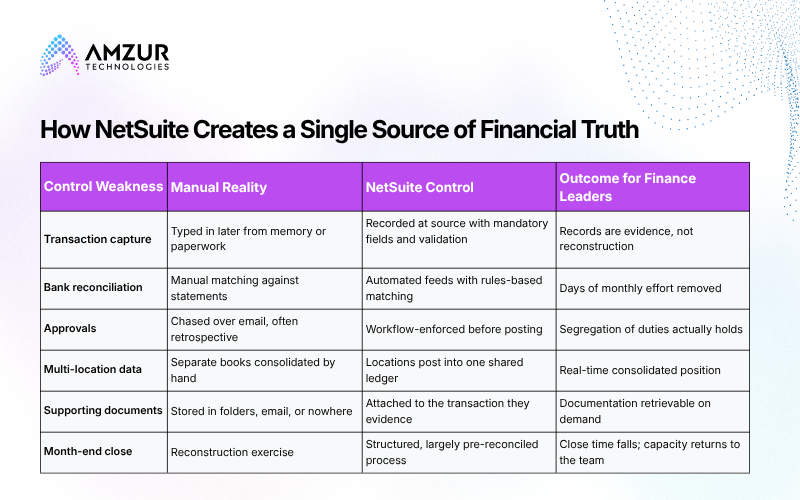
Which NetSuite Capabilities Actually Do the Record-Keeping Work?
Controls only hold if they live inside the transactions your team touches daily. That’s the difference between an accounting tool that stores what you tell it and a system that governs how financial data enters the business in the first place.
NetSuite ERP‘s bookkeeping capabilities split into two layers, and both matter for different reasons.
The first layer is where accuracy is enforced. These are the modules your team works in every day, and each one closes a specific gap that manual financial record-keeping for SMEs leaves open.
Accounts Payable automates vendor bill processing, approval routing, and payment scheduling. Approvals no longer happen over email and start happening before a liability is recorded, which means cash commitments are visible when they’re made rather than when they clear.
Accounts Receivable oversees invoicing, sets credit limits, and tracks collections in real-time. This allows credit exposure to be a visible figure, rather than a judgment made from memory.
The General Ledger maintains a well-structured chart of accounts with a complete audit trail for every transaction. It serves as the authoritative record—the one place where information is reliable, along with a history of how it was recorded.
Bank Reconciliation automatically imports and matches bank and credit card statements with system records. By eliminating manual transcription, it removes the largest single source of error instead of just reviewing it.
The second layer is where accurate data becomes useful. Clean records that nobody can act on quickly are only half the return.
Fast month-end close uses automated allocations, recurring journal entries, and structured checklists to compress a reconstruction exercise into a verification exercise. The close stops consuming the month.
Real-time dashboards surface live cash position, financial metrics, and profit ratios without anyone building a report. Leadership asks a question and gets an answer in the same meeting.
Tax management calculates local and international obligations automatically across jurisdictions. Tax stops being a period-end reconstruction and becomes a continuously accurate figure, which is what makes it defensible if it’s ever challenged.
Each capability moves a control from a person’s discipline into the system’s logic. That is what turns a set of books into a genuine single source of truth for financial data, and why the accuracy holds after the implementation team leaves.
What Changes When Your Numbers Are Trustworthy
When financial record-keeping for SMEs works properly, the shift is bigger than tidier books. Decisions accelerate because nobody re-litigates the data before discussing it.
Tax positions become calculable rather than estimated. Auditors, lenders, and investors get a business that reads as well-run because it demonstrably is.
Most importantly, the finance team you hired to guide the business finally has the time to do it.
Building Records That Hold Up Under Scrutiny
Financial record-keeping for SMEs is not a bookkeeping question. It’s a control design question, and that’s why software alone doesn’t solve it. The controls have to be configured to match how your business actually operates, or the system simply automates the existing mess faster.
Amzur Technologies brings 20 years of NetSuite implementation expertise and more than 200 completed projects to exactly that work. We help growing businesses design the control structure first, then build a NetSuite environment where accurate financial record-keeping for SMEs is enforced by the system rather than depending on anyone’s vigilance.
Talk to Amzur’s NetSuite team about building a finance function your numbers can be trusted from.
Frequently Asked Questions
Why do SME financial records become unreliable as the business grows?
Manual processes that worked at low volume break down under more transactions, locations, and staff. The structure stays the same while the pressure on it multiplies.
Is poor record-keeping a staffing problem or a systems problem?
Almost always systems. Capable teams still produce inconsistent records when there are no control points enforcing accuracy at the moment data is entered.
What is a single source of truth for financial data?
One authoritative ledger that every other system feeds into, so there is never a question of which version of a number is correct.
Can an ERP prevent financial record-keeping errors entirely?
No system eliminates every error, but validation, automated matching, and approval workflows prevent the large majority before they enter the books.
How long does it take to fix weak financial records with NetSuite?
It depends on data quality and process complexity, but the durable gain comes from redesigning controls during implementation rather than migrating existing habits.

Author: Serghino Felix
Sr. Director – Enterprise Applications
Serghino Felix is a seasoned ERP professional with nearly two decades of experience in the enterprise applications space. Known for connecting strategy with execution, he has built a career around turning complex business challenges into scalable, practical solutions, while keeping people and outcomes at the center of every engagement. His expertise spans delivery leadership, customer partnership, and strengthening enterprise application practices that drive real business transformation.